Worry in CBT: Why It Repeats and What the Worry Tree Is For
Worry feels like it is on your side. If you keep going over a problem, surely you will find the answer, or at least be ready for the worst. Most of us have lain awake running "what if" and half believed it was useful work.
But worry has a catch. Going over a problem in your head rarely ends with a solution. It more often ends with more tension and the same question. CBT has more than one explanation of why, and they point to different tools. This article describes three of them, shows how the worry tree fits, and explains where a tree is not enough.
Two kinds of worry
First, separate two things that look alike.
- A worry you can act on. "I have not replied to the landlord and the rent date is close." There is something concrete to do. This is a problem to solve.
- A worry about things you cannot settle. "What if something goes wrong at work? What if I have missed something?" There is no step to take now, and no amount of thinking will give a guarantee. This is the kind that loops.
Many worries are a mix. Part of the work is learning to tell which part is which.
Why worry repeats: three models
Intolerance of uncertainty (Dugas and colleagues). Some people find not knowing hard to bear. Worry looks like a way to get certainty: if I think of every outcome, I will be prepared. But thinking cannot make the future certain, so the wish to be sure is never satisfied and the worry returns. Checking, reassurance-seeking, over-preparing and postponing then bring brief relief, which keeps the pattern going. Treatment includes practicing small amounts of uncertainty on purpose.
Avoidance (Borkovec and colleagues). Worry is mostly verbal, in words and "what ifs", rather than in vivid images. That keeps the emotional side of a threat at a distance. Worrying about a future disaster is less distressing, for a moment, than picturing it. The avoidance relieves a little and prevents the emotional processing that would let the fear settle. This view leads to work on the feared images and feelings behind the worry.
Beliefs about worry (Wells, metacognitive therapy). What keeps worry going, in this view, is what you believe about it. Wells distinguishes two kinds. Type 1 worry is about the world: "What if I lose my job?" Type 2 worry is worry about worrying. Positive beliefs ("worrying keeps me prepared", "it shows I care") make you start Type 1 worry. Negative beliefs ("I can't control it", "it will make me ill", "I'm going mad") produce the worry about worry and the attempts to suppress or avoid thoughts, which tend to backfire. Treatment tests those beliefs and trains a different response: noticing a worry thought and not engaging with it, sometimes called detached mindfulness.
These models are not rivals so much as different angles. A good formulation may use pieces of each.
An example: Linda at midnight
Linda is in bed. "What if I made a mistake in that report? What if my manager noticed? What if I lose my job?" She has gone around this three times and feels more tense, not less. Then a new thought arrives: "I can't switch this off." Now she is worried about the worry.
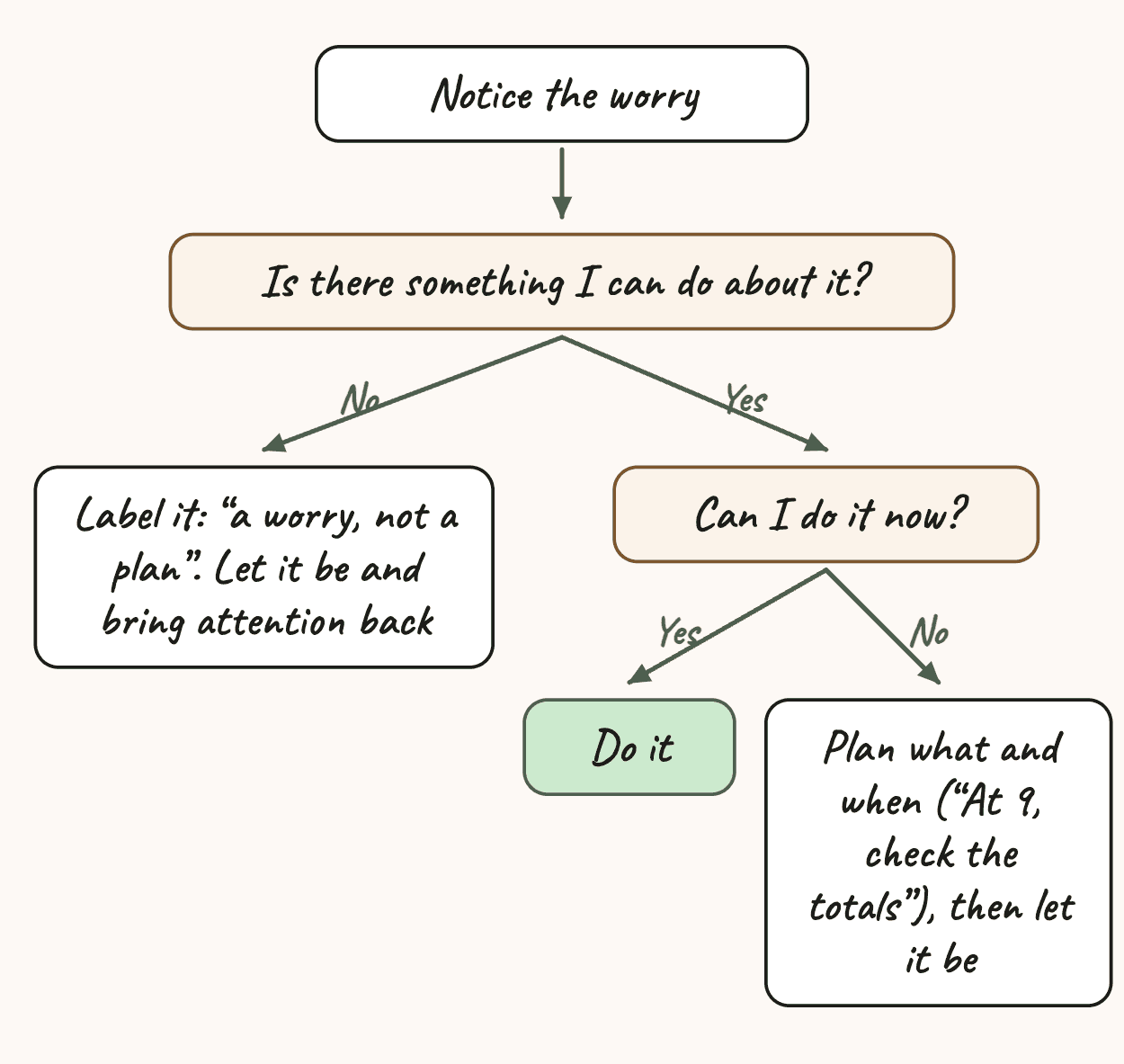
Here is the worry tree applied to the first thought.
Is there something I can do about it?
- Yes, there is. She can check the report totals. It is midnight, so the useful step is to write it down and give it a time: "At 9:00, check the totals on page two." The step and the time let her put the worry down until then. This is problem solving in its simplest form.
- No, or not now. "What if my manager noticed?" has no step. She labels it: "That's a worry, not a plan." Then she lets it be. She does not argue with it, try to push it away or search for a final answer. She brings her attention back to what she was doing, even if the thought comes along. The point is to not engage with it.
The wording matters. "Let it go" can sound like pushing a thought away, and suppression tends to backfire. "Let it be" asks for something different: the thought may stay in the background while you do something else.
The worry tree, step by step
The worry tree is a decision aid from CBT self-help (it appears in Butler and Hope's Managing Your Mind). It does one thing: it sorts.
- Write down the worry. One sentence, in your own words.
- Ask: is there something I can do about it?
- If yes, ask what, and when. Make the step small and specific, with a time. Do it at that time, not before.
- If the step needs doing right now, do it now.
- If no, or it is a "what if" without an answer, name it as a worry and let it be. Return to what you were doing.
- Notice the result. Over time you learn whether a worry left alone is as dangerous as it feels.
Worry time and practicing uncertainty
Some people find it helpful to postpone worry to a short, set period later in the day, say fifteen minutes in the early evening. When a worry appears earlier, you note it and tell yourself, "Later." Postponing is also a test of a belief: that worry has to be dealt with right now. Many people find that some worries lose their urgency by evening.
If the underlying difficulty is a need to be sure, a useful experiment is to practice a small amount of not-knowing on purpose. Send the message without re-reading it a fourth time. Leave the house without checking the door twice. Notice what happens and how you cope. A Behavior Experiment is a good way to structure this, with a prediction written beforehand.
What the tree is not
The worry tree is a sorting aid, not a treatment for generalized anxiety disorder. Everyday worry is normal, and a tree can help. If worry is intense, takes up much of the day, comes with muscle tension, restlessness or poor sleep for months, or feels uncontrollable, a fuller treatment is available. CBT for generalized anxiety combines several of the pieces above: work on intolerance of uncertainty, tests of beliefs about worry, problem solving for the solvable part, and attention training. A therapist can choose among them with you.
A podcast or a puzzle to take your mind off worry is distraction, not the detached stance described above. Distraction can help someone get to sleep, but it does not change your relationship to worry, and it can become another way of avoiding.
What the app adds to a paper worry tree
A worry tree on paper is a flowchart you have to remember to use, usually at the moment you are least able to. In CopingCard the tree is a short path, one question at a time.
- It asks, you answer. You write the worry, then answer whether it is a real problem and whether you can do anything about it. Where the answer is yes, you list options and name what you will do right now, or write what you will do and when. Where it is no, you go to a screen of ways to turn your attention elsewhere; one of them, mindfulness, links to the app's meditations.
- It ends somewhere. Each path reaches an action, a plan or a change of focus, so the worry does not circle.
- It is saved. The finished tree is kept with a picture of the path you took, and the list shows your worries, newest first, so you can look back. A saved tree cannot be edited; to go through the worry again, you make a new one.
- Work on it with your therapist. If you share your data with your therapist, you can go through your trees together, or walk through a new one in session. A worry tree can be assigned as homework, and it counts as done when you reach the end.
Writing down a specific plan has a research basis. In experiments, people who wrote a specific plan for an unfinished goal had fewer intrusive thoughts about it than those who did not (Masicampo and Baumeister, 2011). That supports the "what and when" step, though it comes from studies of everyday goals, not of the app or of generalized anxiety. The plan's time is saved as a note rather than an alarm, so set a reminder on your phone if you need one. The change-of-focus cards, such as music or a journal, are the tree's last step: once you have decided there is nothing to do about a worry right now, you choose where to put your attention. That is different from reaching for distraction every time a worry appears, before you have looked at it.
How to use Worry Trees in CopingCard
In the CopingCard app, open Worry Trees and create a new one.
- Write the worry in your own words.
- Follow the questions: whether there is something you can do, and if so, what and when.
- Write the plan and the time, so you do not need to hold them in mind.
- If it is a worry without a solution, record it as that, and decide what you will do instead: a short walk, a breathing exercise, a meditation from the app.
If you work with a therapist, they can see your worry trees, which makes it easier to spot patterns.
Tips
- Make steps small. "Sort out finances" is a worry. "Open the bank statement Thursday at 6" is a step.
- Do not wrestle with the "what if". Label it, let it be and return to what you were doing.
- Expect worries to come back. That does not mean the tree failed.
- Look for the pattern. If the same worry appears again and again, ask what you do to feel safe, and consider mapping it with a Vicious Cycle.
When to get more help
Please talk to a therapist or your doctor if worry takes up much of your day, keeps you from sleeping for weeks, or comes with panic, low mood or thoughts of harming yourself. Worry that is hard to manage alone often responds well to professional help. In a crisis, open the Crisis tab or contact local emergency services.
Summary
Worry promises certainty and rarely delivers it. CBT explains this through intolerance of uncertainty, avoidance of images and feeling, and beliefs about worry itself. The worry tree sorts worries into those to act on and those to let be. It is a sorting aid; intense, constant worry deserves fuller help.
Sources
- Butler, G., & Hope, T. (1995). Managing Your Mind. Oxford University Press.
- Dugas, M. J., Gagnon, F., Ladouceur, R., & Freeston, M. H. (1998). Generalized anxiety disorder: A preliminary test of a conceptual model. Behaviour Research and Therapy, 36, 215-226.
- Borkovec, T. D., Alcaine, O. M., & Behar, E. (2004). Avoidance theory of worry and generalized anxiety disorder. In R. G. Heimberg, C. L. Turk, & D. S. Mennin (Eds.), Generalized Anxiety Disorder. Guilford Press.
- Wells, A. (1999). A cognitive model of generalized anxiety disorder. Behavior Modification, 23, 526-555.
- Masicampo, E. J., & Baumeister, R. F. (2011). Consider it done! Plan making can eliminate the cognitive effects of unfulfilled goals. Journal of Personality and Social Psychology, 101(4), 667-683. https://doi.org/10.1037/a0024192