Vicious Cycles in CBT: What Keeps a Problem Going
Some problems do not stay the same size. They seem to feed themselves. You feel anxious, you do something to feel better, and a little later the anxiety is back, sometimes stronger. In cognitive behavioral therapy (CBT) this is called a vicious cycle or maintenance cycle: a loop in which thoughts, feelings, body reactions and actions keep each other going.
The idea is old and central. When Dennis Greenberger and Christine Padesky describe the five-part model in Mind Over Mood (situation, thoughts, moods, physical reactions and behaviors, each affecting the others), they are drawing a cycle. When Clark describes panic, or Salkovskis and Warwick describe health anxiety, each model is a specific cycle with its own links. This article explains what a cycle is, how it fits in the wider CBT family, which links tend to matter, and how to draw yours.
Where cycles sit in CBT
CBT therapists work from a formulation: a shared, working explanation of a person's difficulties. A good formulation has at least two levels.
- The "now" level is the maintenance cycle: what keeps the problem going today. This is what a vicious cycle shows.
- The "how it developed" level covers history, core beliefs and rules for living, and why this person became vulnerable to this problem.
Both are useful and they answer different questions. The cycle tells you where change can start in the present. The developmental level helps you understand why the cycle has the shape it has, and often reduces self-blame. CBT does not ignore the past; the maintenance cycle simply focuses on what is keeping the problem alive.
Newer, process-based CBT adds a third idea. Cycles interlock. The same process, such as avoidance, rumination, self-criticism or attention stuck on threat, may be a box in several of your cycles. Those boxes are hubs, and changing a hub can ease several problems at once. Process-based approaches choose methods by the processes that maintain this person's difficulties, rather than by diagnosis alone.
A worked example: Linda and the twinge
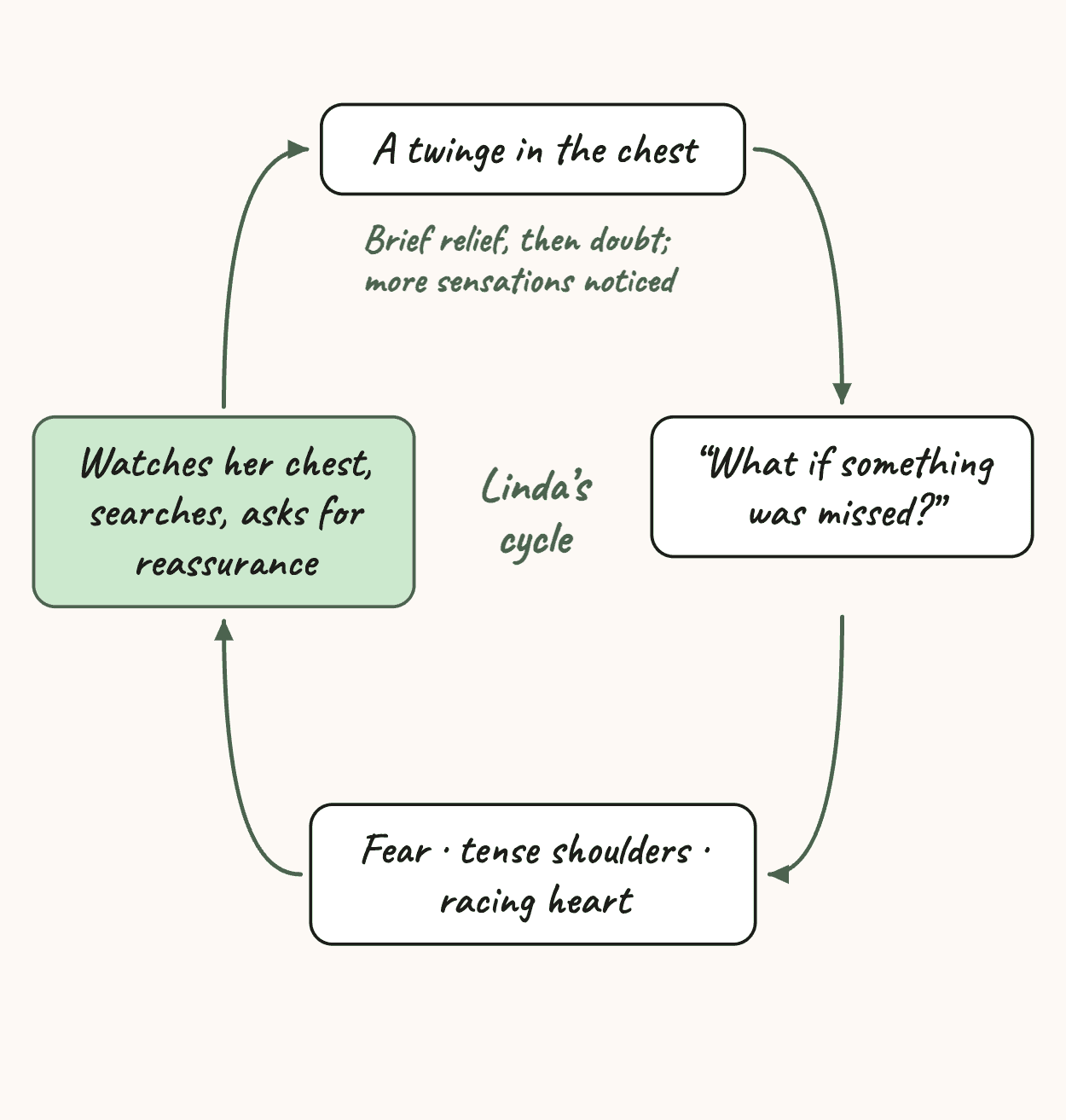
Linda's doctor has examined her heart and told her it is healthy. Even so, one evening she notices a small twinge in her chest while making tea. (A new or changing symptom is different: that is a reason to see a doctor, not a cycle to map.) Here is how a cycle can unfold.
- Trigger: a body sensation.
- Thought: "What if something was missed?"
- Feeling and body: fear, tight shoulders, a faster heartbeat. The faster heart is itself another sensation, which feels like evidence.
- Attention: it locks onto her chest. Sensations nobody normally notices now stand out.
- Action: she searches online, presses on the spot, and asks her sister, "Do you think it's okay?"
- Short-term result: a few minutes of relief.
- Back to the start: "But what if the doctor missed something?" The twinge appears again, and she notices it faster.
The mechanisms in this loop
Two mechanisms do most of the work.
Selective attention. Watching the body increases how much of it you notice. Sensations that are always there become visible, and they look like confirmation.
Safety behaviors. Checking, searching and reassurance-seeking are things we do to feel safe. They bring relief, so they repeat. But they have a cost: they prevent disconfirmation. If the feared outcome never happens, Linda concludes it was the checking that prevented it, not that it was never going to happen. The relief teaches her mind that checking was necessary. In the cognitive model of health anxiety developed by Salkovskis and Warwick, reassurance gives short-term relief and increases doubt in the long term.
The result is a loop that is not held together by a weakness in Linda. It is held together by something that looks like a solution.
The same shape in other problems
Once you know the shape, you see it in many places, each with its own mechanisms.
- Low mood. Mood is low, so you do less or avoid things. You do less, so there are fewer rewarding moments. Fewer rewards, lower mood. Behavioral activation works on this cycle.
- Panic. A sensation, a catastrophic reading ("heart attack", "losing control"), fear, more sensation, and then escape or safety behaviors that stop the belief from being tested.
- Anxiety and avoidance. Something feels dangerous, you feel anxious, you avoid it, you feel relief, and it still feels dangerous because you never tested it.
- Worry. A "what if", a belief that worrying protects you, tension, and checking or over-preparing. See the worry article for detail.
- Rumination. A setback, a "why" question, hours of going over it, a short sense of working it out, and the practical task left undone.
- Social anxiety. An expectation of being judged, attention turning inward, safety behaviors, and the belief that it would have gone badly without them.
In each case, what gives short-term relief (checking, avoiding, going over it, withdrawing) is also a link that keeps the loop going. That is rarely obvious from the inside, which is why a drawing helps.
Why drawing it helps
A cycle that lives in your head feels like one big, vague difficulty. Written down, it becomes a small number of links.
- It shows that each of your reactions makes sense, which lowers self-blame.
- It shows where the loop could be interrupted, and which method fits: a thought can be tested, a prediction can be turned into a behavior experiment, avoidance can be approached in steps, a low-activity loop can be met with activation.
- It gives you and your therapist a shared picture to work from, and a way to check progress: the map changes as you learn.
A limit is worth stating. Changing one link can ease the others, but it depends on the problem. For Linda, the work is more than waiting ten minutes before a check. It means gradually dropping the checking and reassurance (response prevention) while testing a new reading of the sensations, because the checking itself is what prevents the old belief from being updated. That kind of plan is best made with a therapist. A map does not change anything by itself; it shows where to apply a method.
What the app adds to a paper diagram
On paper, a cycle is hard to redraw, and an arrow drawn in the wrong place means starting again. In CopingCard:
- Templates in your language. The app offers ready-made cycles, such as the health anxiety cycle, the checking and reassurance cycle, the avoidance trap and the rumination cycle. A template is a first draft: you change every box into your own words.
- The diagram draws itself. You write each thought, action or fact and tick what it leads to, and the diagram updates as you go. It is drawn on CopingCard's own servers, so what you wrote is not sent to an outside service.
- Easy to revise. The cycle is saved in a list, with a thumbnail of its diagram. You can open it a week later, add the step you noticed since, and save again.
- Work on it with your therapist. If you share your data with your therapist, you can work on your cycles together; they can build one with you in session, starting from the same templates. A cycle can be assigned as homework, and it counts as done when you create a new cycle.
The app draws the map. It does not choose the link to work on, and it does not link a cycle to another tool for you: you decide, with your therapist, whether a thought test, an experiment, an exposure or activation fits. The value of a shared, editable picture comes from case-formulation practice (Persons, 2008), where the formulation is built together and revised as the person learns.
How to draw your own cycle in CopingCard
Vicious Cycles is an advanced CBT technique. If you are not sure how to use it, it can be better to invite your therapist to use it with you. You can invite your therapist or find one in the app. The steps below describe the tool.
- Open Vicious Cycles and create a new one. Name it in plain words about the problem, for example "Checking and relief".
- Start from a template, if one fits. The app has ready cycles for common patterns, such as "The health anxiety cycle" and "The avoidance trap (TRAP)". A template gives you a first draft; edit it into your own words. You can also start blank.
- Add each step. Use Add thought, action or fact for each piece: the trigger, the thought, the feeling, what you did, what happened next. Include what you do to feel better, even if it seems minor, because that step is usually the key.
- Link them. For each step, say what it Leads To. The last should lead back to the first.
- Read it as if it were someone else's. Which link feels most changeable? Which box appears in other cycles you have drawn (a hub)?
- Choose a method that fits the link. A thought: try the Dysfunctional Thoughts Test. A prediction: a Behavior Experiment. Avoidance: Exposures. Low activity: Behavioral Activation. Worry: Worry Trees.
You can return later and change it. People often add steps they notice after a week of watching. That is a good sign.
Tips
- Be specific. "Tight chest, fast heart, thinking I should check" is more useful than "anxious".
- Include the relief. The thing that helps for ten minutes is usually the link that keeps the loop alive.
- Do not blame yourself for any link. A cycle explains how a problem persists; it says nothing about fault.
- Redraw after a week or two. The map should change as you do.
- Look for hubs. The same box in several cycles is a good place to start.
When to get more help
Vicious cycles are a map, not a treatment. Some patterns are hard to see from the inside, and some are tied to experiences that deserve support. If your cycle involves trauma, thoughts of harming yourself, or a pattern that makes daily life very hard, please work on it with a therapist. In a crisis, open the Crisis tab in the app or contact your local emergency services.
Summary
A vicious cycle maps what keeps a problem going today, alongside a formulation of how it developed. Its hidden links are often attention and safety behaviors that bring relief and prevent learning. Cycles interlock around hubs such as avoidance and rumination. A drawing makes your reactions understandable and shows where to apply the method that fits.
Sources
- Clark, D. M. (1986). A cognitive approach to panic. Behaviour Research and Therapy, 24, 461-470.
- Greenberger, D., & Padesky, C. A. (2015). Mind Over Mood (2nd ed.). Guilford Press.
- Hayes, S. C., & Hofmann, S. G. (Eds.). (2018). Process-Based CBT. Context Press.
- Persons, J. B. (2008). The Case Formulation Approach to Cognitive-Behavior Therapy. Guilford Press.
- Salkovskis, P. M. (1991). The importance of behaviour in the maintenance of anxiety and panic: A cognitive account. Behavioural Psychotherapy, 19, 6-19.
- Salkovskis, P. M., & Warwick, H. M. C. (1986). Morbid preoccupations, health anxiety and reassurance. Behaviour Research and Therapy, 24, 597-602.
- Taylor, S., & Asmundson, G. J. G. (2004). Treating Health Anxiety: A Cognitive-Behavioral Approach. Guilford Press.