What Matters to You: Finding Your Values
Dan works long hours and is good at his job. Last month his sister asked when he had last seen her kids, and he could not say. Nothing dramatic had happened. Work had slowly crowded out the people he cares about, one busy week at a time.
If this sounds familiar, you are not alone. When we are stressed, tired or low, life tends to shrink around whatever is urgent. The things that matter most are often the quiet ones, and they are the first to slip. This article explains what values are, why naming them helps, and how to do it step by step with the Values tool in CopingCard.
What is a value?
In Acceptance and Commitment Therapy (ACT) and in behavioral activation, a value is a direction you want your life to point in. "Being a present uncle" is a value. "Being a reliable colleague" is a value. "Being honest" is a value.
A value is different from a goal. A goal can be finished: you can run a 10K, you can get the promotion. A value cannot. You will never be done being a good friend. But you can act on it today, in a small way, and that action often feels worthwhile in its own right, whatever else happens.
This difference matters. When something hurts, it is natural to pull back from whatever carries risk or effort. The life gets narrower. A narrower life offers less meaning and less drive, and that can narrow it further. The loop breaks when something that matters comes back into the week, even in a small form.
Where values come from in therapy
Values are central to acceptance and commitment therapy (ACT), part of the third wave of cognitive behavioral therapy (CBT), and to behavioral activation, a behavioral method with strong support for depression. In ACT, values are chosen qualities of action, not outcomes and not feelings. ACT treats them as one of six linked processes of psychological flexibility: contact with the present moment, acceptance, defusion (stepping back from thoughts so they guide you less), the observing self, values and committed action. Values give the other processes a point. Willingness to feel discomfort is easier to find when it is for something. In behavioral activation, the same idea appears as choosing activities that fit what matters to you, in order to lift mood through action.
Newer is not automatically better: in a meta-analysis of 39 trials, ACT did not differ significantly from established CBT. Values work is one useful tool in the family, and it fits some people and some moments better than others.
Values are not rules
Values are not what you think you should care about, and they are not what other people expect of you. If "career" is on your list only because it sounds impressive, it is not yet a value of yours. There are no right or wrong answers here. Two people can sort the same cards and end up with completely different results, and both are correct.
Values also change. What mattered in your twenties may not be what matters now. Looking again every so often is part of the practice.
Three ways to look at your values in CopingCard
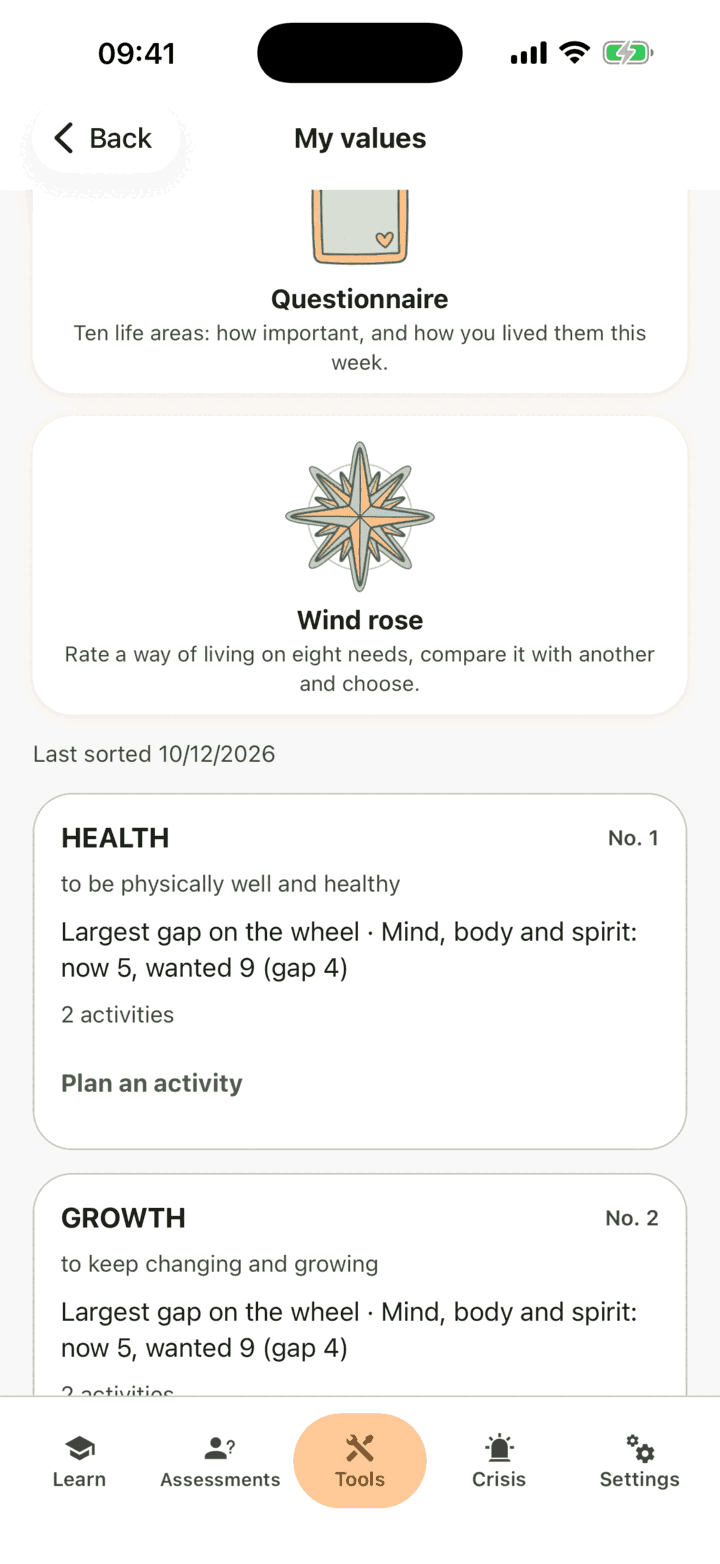
The Values tool is in the Toolkit. It opens on a page called My values, which collects everything you do in one place. It has three doors.
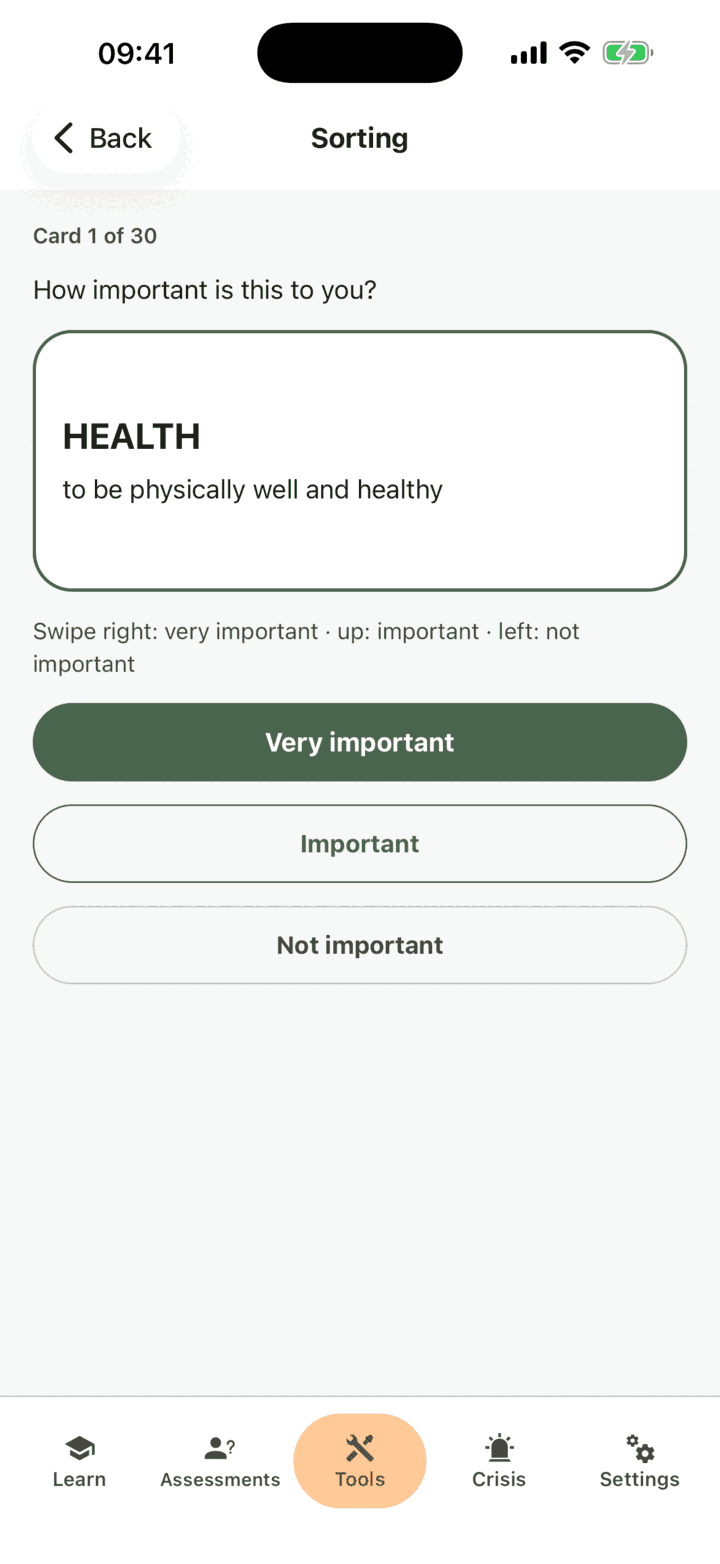
The card sort. You see one card at a time, each naming a value such as family or honesty, with a short note on what it means. For each card, you decide whether it is very important, important or not important to you. You can swipe right for very important, up for important, and left for not important, or tap. Then you put your very important cards in order, with the one that matters most first. You need at least three very important values, and up to ten are kept in your order. The quick set has 30 cards and takes about four minutes. The full set has 83 cards and takes about ten. The cards come from the Personal Values Card Sort, which is in the public domain.
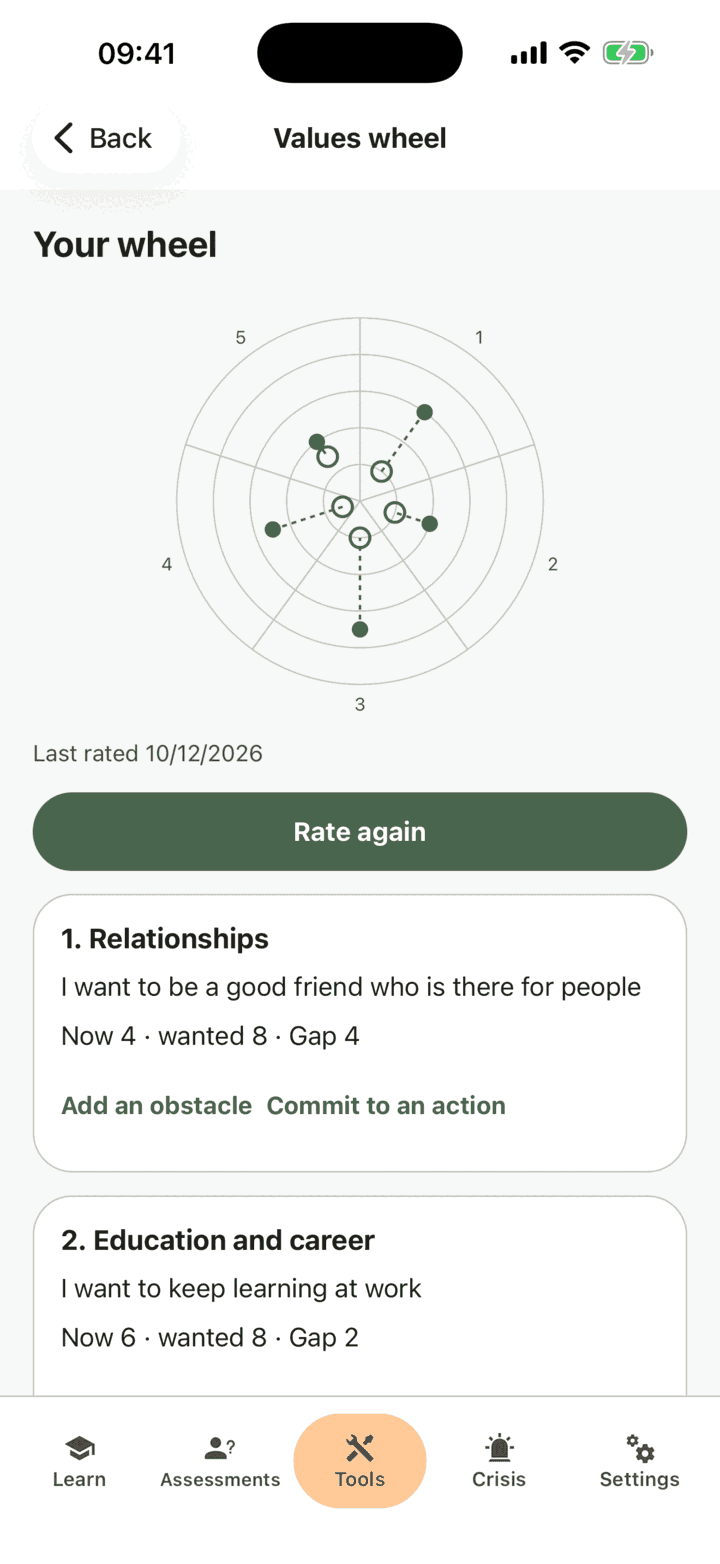
The values wheel. A wheel has an area for each part of life you want to look at. You choose a set: four areas (the bull's eye), five, eight (a wheel of life), or your own names. Then you rate each area twice, from 0 to 10: where you are now, and where you want to be. The distance between the two marks is the gap, and it is shown for each area. Hold the gap lightly. It tells you where your life and your values part ways this week. It is not a grade, and a wide gap is not evidence that you are failing at your own life. If looking at it brings on self-criticism, notice that, and bring it to your therapist.
The questionnaire. Ten areas of life, including family, friendships, work, education, recreation, spirituality, community and physical self-care. For each, you rate how important it is to you and how consistently you lived it this past week, from 1 to 10. You get a score that rises when you live closer to what matters to you, and a list of the areas with the biggest gaps first. Take it again later to see what changes.
You do not need to do all three. Many people start with the card sort and go to the wheel only if they want to see the gaps.
What Dan found
Dan did the quick card sort on a Sunday evening. Family landed near the top, along with honesty and health. Work was on his list too, but lower than he expected.
He set up a wheel with his own area names. In the family area he rated himself 2 out of 10 now, and 8 out of 10 wanted. That was the widest gap on his wheel, and seeing it written down in front of him was uncomfortable, and also a relief. It was true, and now it was visible.
What Dan did next is the important part. He did not try to rearrange his life. He did not promise to be home by six every night. He chose one small, specific action: a video call on Sunday afternoons with his sister's kids. He wrote it into his week.
What the app adds to a card deck and a worksheet
A paper card sort and a worksheet can show you what matters. They do not carry the result into your week, and they are easy to put in a drawer. In CopingCard the result stays connected to what you do next.
- A dated action with a nudge. When you commit to an action, you give it a day and time. It goes on your Homework list, a nudge arrives when it is due, and you can put a copy in your calendar. A plan that says when it will happen is more likely to be carried out than a general intention (Gollwitzer and Sheeran, 2006).
- One place that keeps the thread. My values shows your ranked values, the largest gap on the wheel and in the questionnaire for each, and the actions you committed to, marked to do or done.
- Repeat ratings you can compare. You can rate the wheel again or take the questionnaire again. Earlier ratings stay, and the questionnaire shows the change since last time, so you can see whether a gap has moved.
- Links to your other tools. In Behavioral Activation, the ideas for the values you ranked first come first, with a rough difficulty. A coping card can be linked to a value. The ideas that you ask for are made by AI, and you choose what to keep.
- Work on it with your therapist. If you share your data with a therapist in CopingCard, you can go through your profile together; they can rate the wheel with you in session (marked as rated in session), and assign the card sort, the wheel or the questionnaire as homework. It is marked done when you finish it.
The case for a dated action comes from research on planning. The value of repeat ratings and of the links between tools rests on the method of values work itself.
From a value to a small action
A value gives you a direction. An action is a step along it. Here is how to move from one to the other in the app.
- Pick one value from your profile. Choose the one with the widest gap, or the one that feels most alive today. Not three. One.
- Choose a small action. Small means you could do it this week without a big change. The Activities page lists ideas for each value, from the easiest to the hardest. You can add your own or ask for ideas, which are made by AI, so choose only what fits you. Start at the easy end.
- Be specific. "See family more" is a wish. "Call on Sunday at 4" is an action.
- Tie it to something you already do. An action attached to an existing routine is much easier to keep. Dan placed his call right after his Sunday lunch.
- Commit to it in the app. When you commit to an action, it is added to your homework for yourself, and it comes back to your profile when it is done.
If a week passes and the action did not happen, that is information about the plan, not about you. Maybe the time was wrong, or the step was too big. Change the target or the technique, and try again.
Obstacles: practical and inner
Every value has obstacles. Some are practical: a schedule, a distance, a cost. For those, the usual answer is a smaller or better-timed step. On the wheel you can name the obstacles for an area and think about them before they get in the way.
Others are inner: tiredness, awkwardness, a voice saying "you'd rather be alone." Shrinking the step helps, but it does not remove them, because moving toward what matters brings discomfort with it. Here ACT adds two things. The first is willingness: choosing to feel the awkwardness, without liking it, because the action matters to you. The second is defusion: noticing "I'd rather be left alone" as a thought passing through, rather than an instruction.
Dan's obstacle was that Sundays often felt flat. He made the call short, ten minutes, and kept it. He felt the flatness and called anyway. It went better than he predicted, which happens often, but it is not the point. The point is that he acted in the direction he chose while the discomfort was present. If it had gone badly, the action would still have been his.
Using it with your therapist
If you work with a therapist, bring your profile to a session. It gives both of you a map of what treatment is for. Your therapist may also ask you to do the card sort or the wheel between sessions, and the app marks it done when you finish.
When to get more help
Thinking about what matters can bring up strong feelings, including sadness about time lost or a sense that the gap is too wide to close. That is normal, and you do not have to go through it alone. If the feelings are heavy or last for days, talk to your therapist or your doctor. If you feel unsafe at any point, open the Crisis tab in the app, or contact your local emergency services.
In short
- A value is a direction you can act on today. It is not a goal you finish.
- The card sort, the wheel and the questionnaire each show something different: what matters, where you are, and the gap.
- Start with one value and one small, specific action.
- A missed day tells you about the plan, not about you.
- Your values can change, so come back to them.
Related: The Wind rose and Getting active.
Sources
- Hayes, S. C., Strosahl, K. D., & Wilson, K. G. (2011). Acceptance and Commitment Therapy (2nd ed.). Guilford Press.
- A-Tjak, J. G. L., et al. (2015). A meta-analysis of the efficacy of acceptance and commitment therapy. Psychotherapy and Psychosomatics, 84(1), 30-36.
- Martell, C. R., Addis, M. E., & Jacobson, N. S. (2001). Depression in Context. W. W. Norton.
- Lejuez, C. W., et al. (2011). Ten year revision of the brief behavioral activation treatment for depression. Behavior Modification, 35(2), 111-161.
- Miller, W. R., C'de Baca, J., Matthews, D. B., & Wilbourne, P. L. (2001). Personal Values Card Sort. University of New Mexico.
- Wilson, K. G., Sandoz, E. K., Kitchens, J., & Roberts, M. (2010). The Valued Living Questionnaire. The Psychological Record, 60, 249-272.
- Lundgren, T., Luoma, J. B., Dahl, J., Strosahl, K., & Melin, L. (2012). The Bull's-Eye Values Survey. Cognitive and Behavioral Practice, 19(4), 518-526.
- Gollwitzer, P. M., & Sheeran, P. (2006). Implementation intentions and goal achievement: A meta-analysis of effects and processes. Advances in Experimental Social Psychology, 38, 69-119.