CBT Techniques: Exposure
Exposure is one of the central methods of cognitive behavioral therapy (CBT). It is used for phobias, panic, social anxiety, obsessive-compulsive disorder (where it is combined with response prevention) and post-traumatic stress. It is also one of the most misunderstood. Many people hear "facing your fears until they go away" and picture something like being thrown in at the deep end. That is not how it is done, and it is not how it works.
This article explains where exposure comes from in the CBT family, what current research says it does, how a good exposure is planned, and how to practice it in CopingCard. If you have strong fears, panic or trauma, please do this work with a therapist; there is a note on that below.
Where exposure comes from
Exposure belongs to the behavioral core of CBT, the oldest thread of the family. Behavior therapists in the 1950s and 1960s applied what was known about learning: when we avoid something frightening, the relief teaches us that avoiding worked, so the pull to avoid grows and the feared thing is never tested. Early forms such as systematic desensitization paired a hierarchy of feared situations with relaxation. Later forms dropped the relaxation and put the weight on approaching what is avoided, repeatedly.
Exposure combines with the rest of CBT. A cognitive therapist uses it as a behavior experiment: the exposure tests a prediction ("if I stay, I will faint"). In OCD it is paired with response prevention, which means not doing the compulsion. In acceptance and commitment therapy (ACT), it is approached with willingness, as a way to move toward what you value while fear is present. And in process-based CBT it is chosen when avoidance is the process keeping a person's problem going.
Why avoidance keeps fear alive
Avoidance has an immediate payoff: relief. The mind concludes "that was close, good thing I left." Next time the pull to avoid is stronger, and the list of avoided things slowly grows. Because you never go, you never find out whether the feared outcome would have happened.
There is a second layer. Safety behaviors, the small things we do to feel safer while still doing the feared thing, work the same way. Carrying water "in case I faint," standing near the exit, checking your pulse, having someone come with you, or rehearsing what to say can feel protective. But they also prevent learning. If nothing bad happens, you conclude that the safety behavior saved you, not that the danger was overestimated.
What exposure does: inhibitory learning
For decades the explanation was habituation: stay with a feared situation until the anxiety falls, and the fear fades. Current research (Craske and colleagues) supports a different account, called inhibitory learning.
According to this account, old fear memories are not erased. Exposure builds a new memory beside the old one ("I stayed, and I did not collapse"), and the two compete. The new learning is stronger when it is surprising: when what happens differs from what you expected. This is expectancy violation.
Three consequences for how exposure is planned follow.
Track the expectation, not only the fear. Before a step, you write what you expect to happen and how likely it seems. After, you record what actually happened and what you learned. How scared you felt during the step matters less than whether your prediction came true. A step can be uncomfortable and still teach well. Feeling scared during a step is expected, and it does not mean the step went wrong.
Vary the practice. Different places, times of day, people and ways of doing the same step make the new learning hold up across situations, so it does not belong only to one shop or one room.
Drop safety behaviors, one at a time. Taking away the water, the exit seat or the pulse check lets the prediction be tested properly.
Steps are chosen for what they can teach, not for comfort. And exposure does not need to start with the worst fear. It can begin with a step that is hard but doable and build from there.
An example: Dan in the supermarket
Dan had a panic attack in a crowded supermarket. His heart pounded, he felt dizzy, and he was sure he would collapse and everyone would stare. Since then he relies on others to buy groceries, or goes late at night. If he has to go in, he stays near the exit, carries water and checks his pulse.
Before starting, Dan saw his doctor, who confirmed his heart is healthy. With his therapist, he works out what exactly he fears: not the shop itself, but fainting and being humiliated. That is the prediction to test.
His first step: go into a quiet shop at a quiet time and stay for ten minutes without the water bottle. He writes the prediction: "I'll feel dizzy and I'll faint; 70%." After the step: "I felt dizzy for a few minutes; I did not faint." He rates how likely it feels now (30%) and writes what he learned: "Dizzy is not the same as fainting." The next steps vary the setting and add difficulty: a busier time, a bigger store, no hovering by the exit.
Because Dan fears the sensations themselves, his therapist may add interoceptive exposure: deliberately producing dizziness or a racing heart in a safe setting, such as spinning in a chair or breathing fast for a short time, to learn that the sensations are unpleasant but not dangerous. This is part of CBT for panic, and it follows from Clark's cognitive model, in which the catastrophic reading of body sensations keeps panic going. Interoceptive exposure should be used after a medical check and, ideally, with a therapist.
Dan also thinks about what he values. He wants to be able to do his own shopping again and not feel afraid of ordinary life. Fear may be present on the way. Being willing to feel it, in the service of that, is part of the work.
Not every result is clean. If, on one of the steps, someone does glance at Dan, the question becomes "Can I cope with that?" That is also useful information, and the next step can test it.
The four kinds of exposure
- In vivo exposure: real situations, objects or places.
- Imaginal exposure: vividly imagining a feared scene or memory, often in trauma-focused work.
- Exposure to thoughts: approaching intrusive thoughts or images rather than pushing them away.
- Interoceptive exposure: approaching feared body sensations.
General steps for planning an exposure
- Name the fear and what you predict. Not "supermarkets" but "I'll faint and people will stare."
- Notice what you avoid and what safety behaviors you use.
- Build a hierarchy: a ladder of situations from easier to harder, with several steps, so you can climb gradually.
- Choose a step that is hard but doable, and write the prediction and how likely it feels.
- Do it, with fewer safety behaviors, and stay long enough to see what actually happens.
- Record the outcome and what you learned, and how likely the prediction feels now.
- Repeat and vary, across places, times and people, and move up the hierarchy.
- Keep going after the hierarchy. Return to situations from time to time so the learning stays alive.
What the app adds to a paper exposure plan
A hierarchy on paper is a good start. The hard parts are keeping the prediction honest, noticing change, and doing the next step. CopingCard helps with each.
- A prediction you cannot quietly rewrite. Before a session you write what you fear will happen and how likely it seems. When you tap Start, the app locks both answers. Afterwards you record whether it happened, how likely it feels now, and what you learned. Tracking the expectation, and comparing it with the outcome, is the core of the inhibitory learning approach (Craske and colleagues, 2014).
- Readings and a graph. During a session you add a stress rating whenever your feeling changes. Each session is drawn as its own line on the situation's graph, and the session card repeats your answers, for example 80% before and 30% after. If a reading came out wrong, you can correct it; the app keeps the original beside the correction.
- A hierarchy you can reorder. Each situation has a stress rating and an answer to "Do you avoid this?", and you move rungs up or down as you learn.
- Work on it with your therapist. If you share your data with your therapist, you can work on the hierarchy and the session answers together. With editing allowed, they can build a hierarchy with you or run a session in the room. They can assign an exposure as homework, once or on repeat, with a reminder at the due time. It counts as done when you finish a session.
Why this matters: homework completed between sessions goes with better outcomes in CBT (Kazantzis and colleagues, 2016), and a record that holds your prediction beside what happened is the evidence inhibitory learning asks you to look at. The app does not tell you whether a step worked; it keeps the pieces in one place so you and your therapist can read them. You can also add an exposure to your own homework, on repeat, to get the same reminders.
Exposure in CopingCard
This short video shows a quick overview of how you can use the Exposure technique both in the Provider Platform and in the mobile app.
In the mobile app, Exposures lets you describe a fear or worry and build a hierarchy of situations or stimuli. You choose the type: Graduated Exposure, or Exposure and Response Prevention, where you also write the obsession, the compulsion and the safety behaviors you want to reduce. The Provider Platform lets therapists create exposures and hierarchies for clients, so the technique can be explained in session, and it can generate a hierarchy draft with generative AI that the therapist then edits.
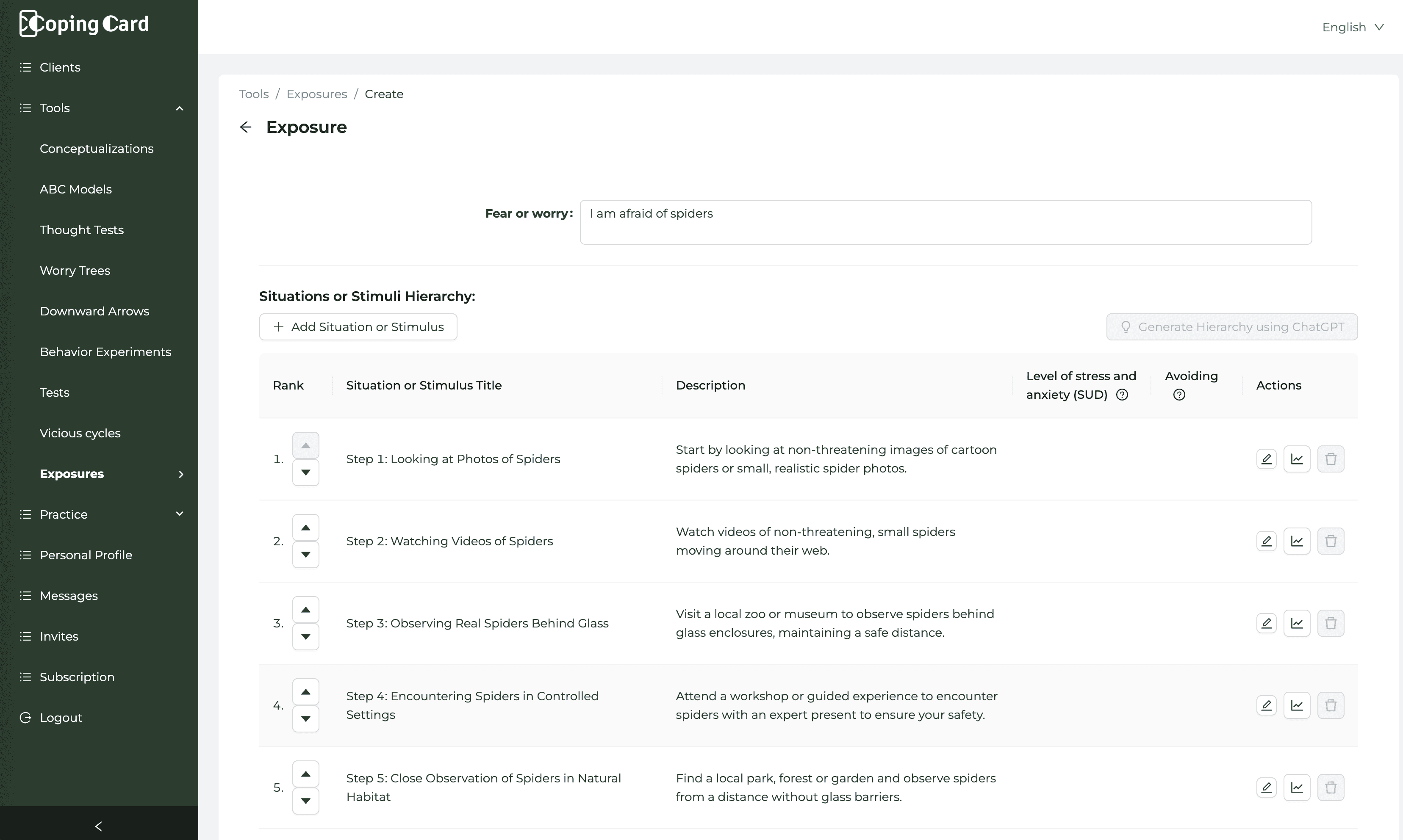
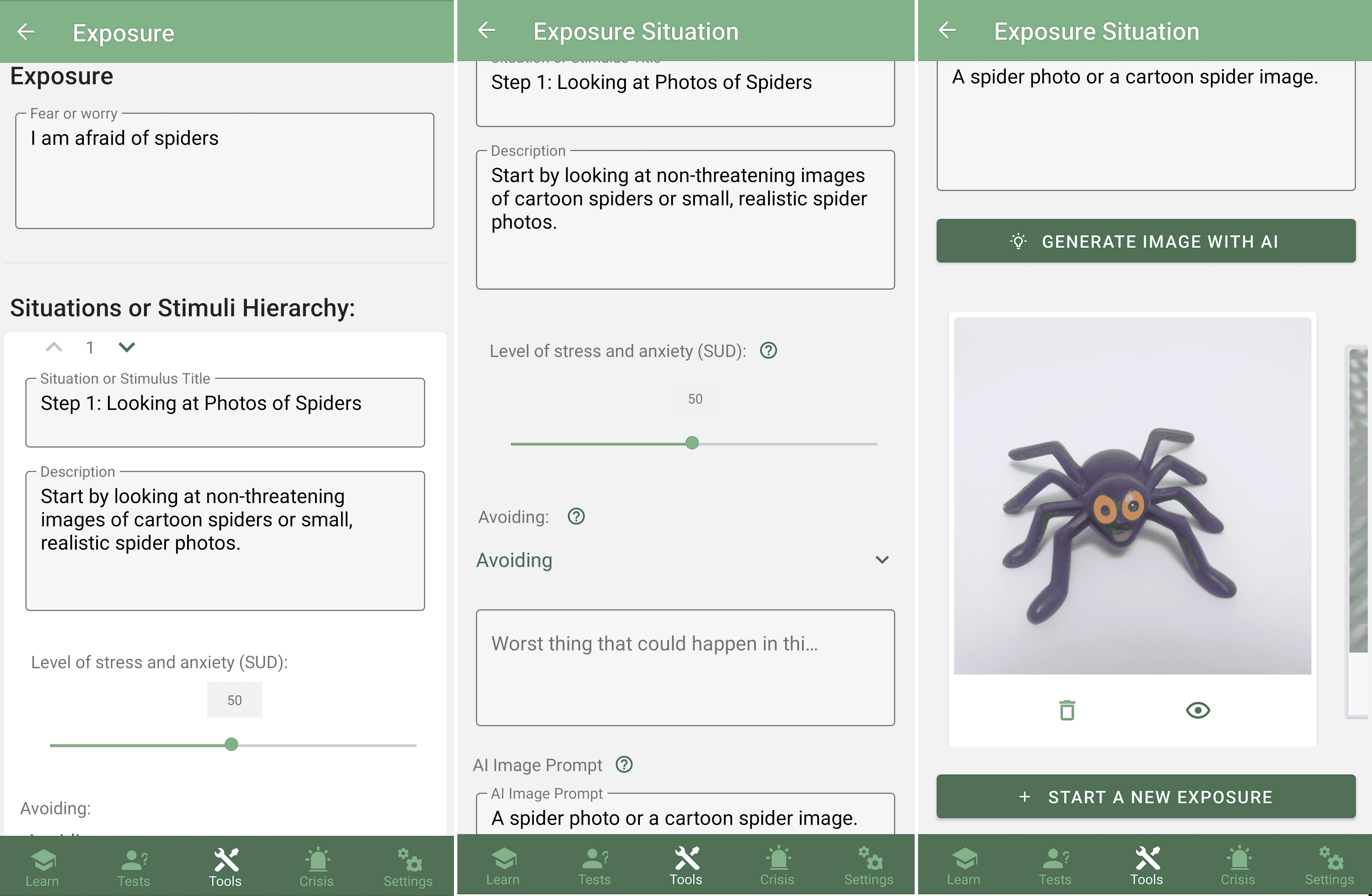
Each situation or stimulus can carry a description and, optionally, an AI-generated image, which helps at steps where the exposure is imaginal or involves looking at pictures.
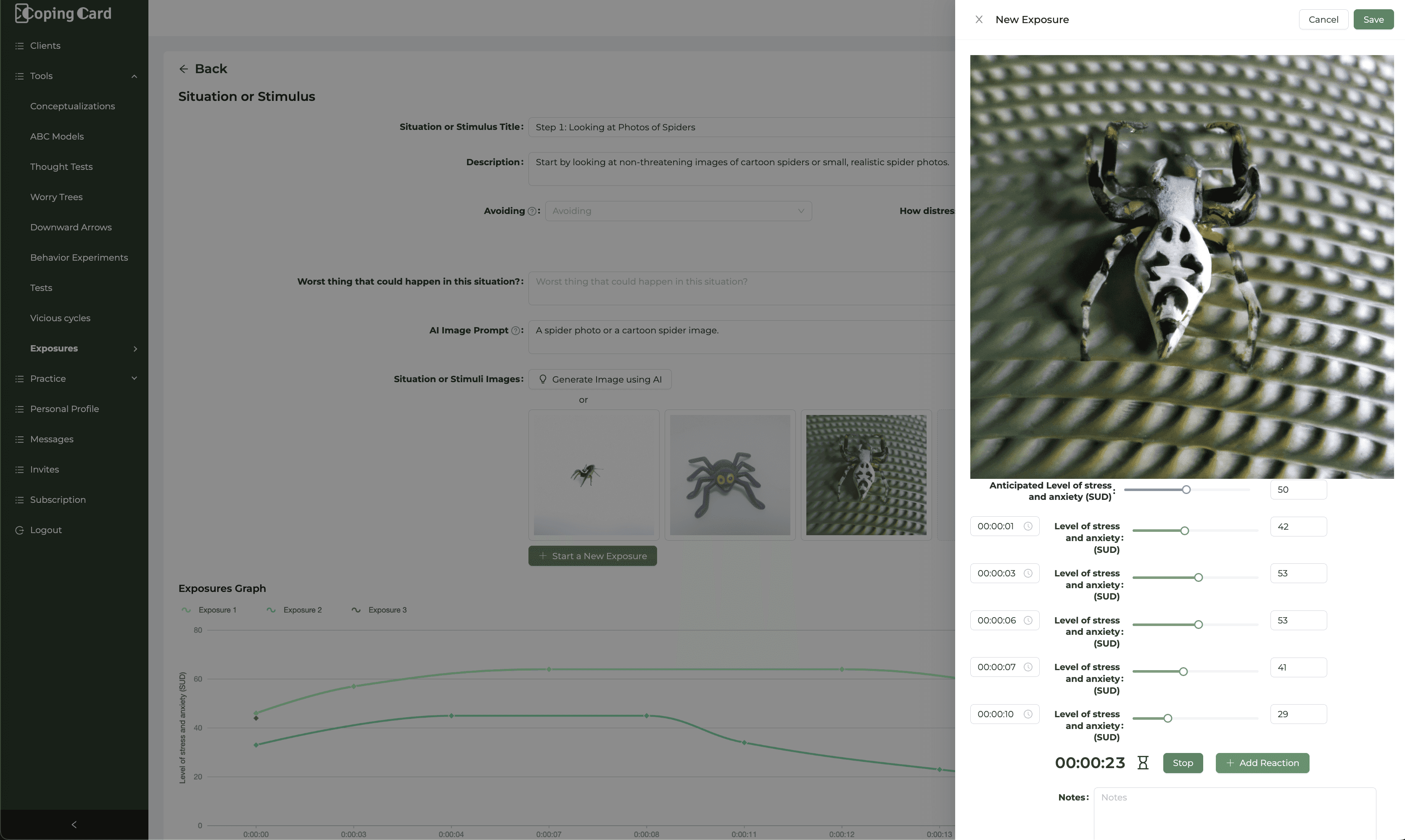
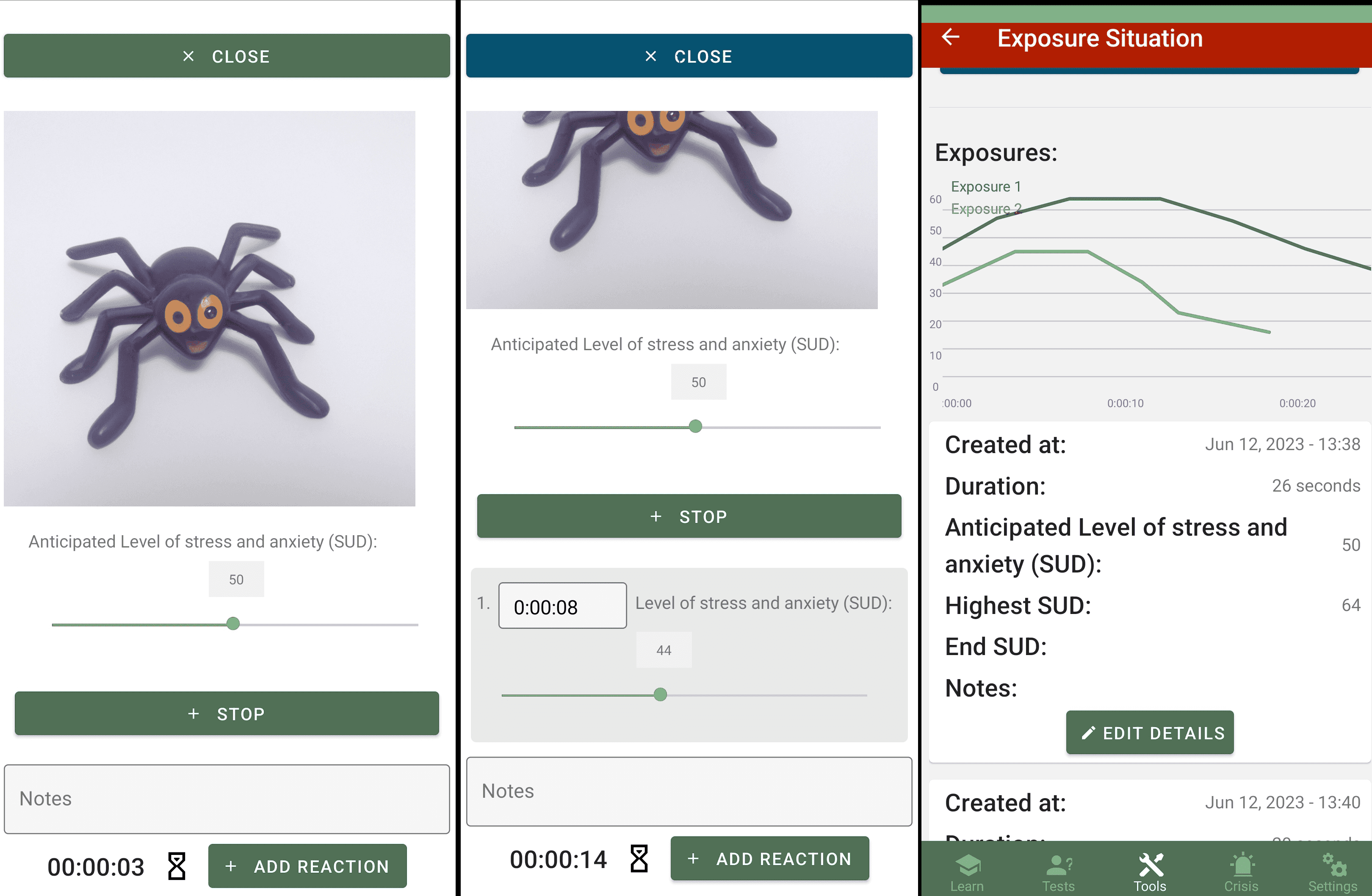
Each time you practice, you start an exposure session and answer the optional expectancy questions: "What do you fear will happen?", "How likely is it?", and afterwards "Did it happen?", "How likely does it feel now?" and "What did you learn?" You can also rate your level of stress and anxiety on a 100-point scale as you go, and the app draws each session as a line on a graph so you can compare sessions. A rating of distress is useful information, but the question that matters most is whether the prediction came true.
What exposure is not
- It is not "facing fears until they go away." The goal is new learning, and you may still feel fear while it happens.
- It is not flooding yourself on the first day. Steps are planned, and you choose them.
- It is not relaxation. Calming techniques are fine for any moment, but they are not a condition for exposure, and used during a step to get through it they can become safety behaviors.
- It is not for working through trauma alone.
When to get more help
Strong fears, panic and anything linked to trauma are best worked on with a therapist, who can plan the steps with you and keep them manageable. For PTSD, trauma-focused CBT and prolonged exposure are delivered by trained clinicians. If you have a medical condition, check with your doctor before interoceptive exercises.
Sources
- Craske, M. G., Treanor, M., Conway, C. C., Zbozinek, T., & Vervliet, B. (2014). Maximizing exposure therapy: An inhibitory learning approach. Behaviour Research and Therapy, 58, 10-23. https://doi.org/10.1016/j.brat.2014.04.006
- Clark, D. M. (1986). A cognitive approach to panic. Behaviour Research and Therapy, 24(4), 461-470.
- Foa, E. B., & Kozak, M. J. (1986). Emotional processing of fear: Exposure to corrective information. Psychological Bulletin, 99(1), 20-35. https://doi.org/10.1037/0033-2909.99.1.20 (the habituation-era emotional processing theory that inhibitory learning builds on and refines)
- Kazantzis, N., Whittington, C., Zelencich, L., Kyrios, M., Norton, P. J., & Hofmann, S. G. (2016). Quantity and quality of homework compliance: A meta-analysis of relations with outcome in cognitive behavior therapy. Behavior Therapy, 47(5), 755-772. https://doi.org/10.1016/j.beth.2016.05.002
- Norton, P. J., & Price, E. C. (2007). A meta-analytic review of adult cognitive-behavioral treatment outcome across the anxiety disorders. The Journal of Nervous and Mental Disease, 195(6), 521-531. https://doi.org/10.1097/01.nmd.0000253843.70149.9a
- Hayes, S. C., Strosahl, K. D., & Wilson, K. G. (2012). Acceptance and Commitment Therapy (2nd ed.). Guilford Press.
- Springer, K. S., & Tolin, D. F. (2020). The Big Book of Exposures: Innovative, Creative, and Effective CBT-Based Exposures for Treating Anxiety-Related Disorders. New Harbinger.
If this brings up something difficult, you don't have to deal with it alone. Talk to your therapist, or open the Crisis tab in the CopingCard app.