Why Practice Mindfulness? What It Is, How It Works, and Its Limits
Linda lies awake and the "what ifs" start. What if the test result is bad? What if I missed something? What if I cannot cope? Each question opens the next. An hour later she is exhausted and no closer to an answer. She did not decide to worry. Her attention was captured, and she followed it.
Mindfulness is one of the oldest and most studied ways of working with exactly this. It is also one of the most misunderstood. This guide explains what mindfulness is, why it is not relaxation, how it fits into the family of CBT therapies, what researchers think makes it work, what the research does and does not show, who should be careful, and how to begin with the Meditations tool in CopingCard.
What mindfulness is, and what it is not
Jon Kabat-Zinn, who developed the Mindfulness-Based Stress Reduction (MBSR) program in the late 1970s, described mindfulness as paying attention in a particular way: on purpose, in the present moment, and without judgment. A widely cited proposal by Bishop and colleagues (2004) splits this into two parts: self-regulation of attention, so that it stays on what is happening now, and an orientation of curiosity, openness and acceptance toward whatever appears.
The common picture is different: a calm person with a quiet mind. That picture causes trouble. If you believe mindfulness is relaxation, a session in which you feel restless or sad looks like failure. It is not. Relaxation is a goal about how you feel. Mindfulness is a practice about how you relate to what you feel. Calm often follows, but not always, and it is not the measure. A session in which you notice, again and again, that you are anxious, and let that be, is a session that worked.
Nor is mindfulness positive thinking, suppressing thoughts, or emptying the mind. Minds produce thoughts; the practice is to notice them without being taken over.
Where it sits in the CBT family
Mindfulness entered CBT through the "third wave," which paid more attention to the function of a thought, and to the person's relationship with it, than to its content (see our guide, "What Is CBT?"). Three versions are relevant here.
Mindfulness-based cognitive therapy (MBCT), developed by Zindel Segal, Mark Williams and John Teasdale, combines mindfulness practice with ideas from cognitive therapy in an eight-week group course. It was designed to prevent relapse in people who have recovered from depression but have had it before.
Acceptance and commitment therapy (ACT) treats contact with the present moment as one of six processes of psychological flexibility. It sits beside defusion (stepping back from thoughts), acceptance, the observing self, values and committed action.
Dialectical behavior therapy (DBT) teaches mindfulness as the foundation of its skills. Its "what" skills are observe, describe and participate. Its "how" skills are nonjudgmentally, one-mindfully (one thing at a time) and effectively. The other DBT skills, such as handling distress or regulating emotion, build on them.
Metacognitive therapy has a related idea called detached mindfulness: noticing a worry or a ruminative thought as an event and not engaging with it. It is not suppression and it is not distraction.
How it works: the mechanisms researchers propose
Mindfulness is not a single ingredient. Several mechanisms have been proposed, and they overlap.
Attention control. Each time you notice that your attention has wandered and you bring it back, you practice a small act of control: noticing a drift, disengaging, and redirecting. Over repetitions this strengthens the ability to leave a chain of thoughts, which matters when worry and rumination pull attention again and again to the same place. Hölzel and colleagues (2011) call this attention regulation, one of four proposed components, along with body awareness, emotion regulation and a change in perspective on the self.
Decentering, or metacognitive awareness. Mindfulness practice builds the ability to see a thought as a mental event instead of a fact. "I am a failure" becomes "I am having the thought that I am a failure." The thought may still be present, and it may still hurt, but it is no longer the whole picture. Teasdale and colleagues (2002) found that how readily people with past depression could take this stance toward negative thoughts predicted relapse, and suggested that cognitive therapy and MBCT may reduce relapse by changing the relationship to thoughts rather than belief in their content. This is a different route from the one in thought testing, where you examine the evidence for a thought: here you change your relationship to the thought, not its content. Both are valid, and a good therapist chooses between them.
Less reactivity and less avoidance. Many problems are kept going by trying not to feel something. Mindfulness practice involves staying with a discomfort, such as a restless body or an unwanted feeling, long enough to see that it rises and falls. This resembles exposure: the person learns that the feeling can be tolerated and does not need to be fought or fled.
Doing mode and being mode. MBCT describes two ways the mind works. In doing mode, the mind notices a gap between how things are and how it wants them to be, and works to close it by analyzing, planning and problem solving. That is helpful when a problem can be solved. When the "problem" is a feeling or a memory, doing mode circles: "Why do I feel this way? What is wrong with me?" Being mode is a different stance: it notices what is here and allows it, without needing to fix it. Linda's night-time worry is doing mode with nothing to do. Practicing being mode is one way of stepping out of it.
What the research does and does not show
Mindfulness is often over-sold, so precision matters.
The best-studied use is MBCT for relapse prevention. In the first trial (Teasdale and colleagues, 2000), people who were well but had had two or more past episodes of depression were randomized to MBCT or usual care. Over about a year, MBCT lowered the chance of relapse, and the benefit was clear for people with three or more previous episodes. A pooled analysis of nine randomized trials with individual patient data (Kuyken and colleagues, 2016) found that people who received MBCT had a lower risk of relapse over 60 weeks than people who did not. In the four trials that compared MBCT directly with continuing maintenance antidepressants, the risk of relapse was lower with MBCT, though the designs of those trials differed. A separate large trial (Kuyken and colleagues, 2015) that compared MBCT with support to taper antidepressants against maintenance antidepressants found no clear difference between them.
Read this precisely. It concerns adults in remission from recurrent depression, taught in a structured eight-week course by trained teachers. It is evidence that MBCT can help prevent relapse and that it is a reasonable option alongside medication. It does not show that a few minutes of meditation treats depression, anxiety, trauma or psychosis, and it does not make mindfulness a replacement for therapy or medication.
CopingCard's Meditations are not the MBCT or MBSR programs. They are short guided sessions that offer practice in the same kind of attention. They can be a starting point, or a supplement to therapy. They do not reproduce what was tested in the trials.
Risks and who should be careful
Meditation is not harmless for everyone. A systematic review (Farias and colleagues, 2020) of 83 studies found that adverse effects during or after meditation, such as increased anxiety, low mood and unusual perceptual or cognitive experiences, are reported in a meaningful minority of participants, even in people with no history of mental health problems. The rates varied a great deal by study design, and in controlled trials they were lower than in observational studies, but they are not rare enough to ignore.
Sitting quietly with your body and thoughts may bring up difficult feelings or memories, especially after trauma or during a depressed period, and some people feel more anxious or detached. If that happens:
- You can stop. Open your eyes, look around the room, and feel your feet on the floor.
- Shorten the session, or use an eyes-open practice, or return to the present with your senses.
- Tell your therapist. It is useful information, and some practices may need adapting for you.
If you have a history of trauma, psychosis or severe depression, talk to your therapist before starting regular meditation.
What the app adds to a practice
Mindfulness is a skill that grows with repetition, and most people who stop do not stop on purpose: the day fills up. The app is built around making the next session easy to start.
- Short guided sessions. Guided meditations, each a few minutes long. Audio keeps playing when you lock your phone or switch apps, so you can listen in bed with the screen dark.
- A reminder you set once. Add a meditation to your own homework and choose daily, weekly on chosen days, or monthly, at a time you pick. The app reminds you then, and you can add the homework to your phone's calendar. This fits the advice below to attach practice to a cue you already have, such as after breakfast.
- Work on it with your therapist. A therapist can assign a meditation as homework. It counts as done when you listen to one to the end after it was assigned. If you share your data, they see how many meditations you started over time.
Why this matters: in a review of studies of MBCT and MBSR, how much people practiced at home had a small positive link with how well they did (Parsons and colleagues, 2017). Reminders make regular practice easier to keep up. The app does not measure the quality of your attention, and a reminder is no substitute for a teacher when practice stirs up difficult feelings.
How to start with Meditations in CopingCard
The Meditations tool has short guided sessions, such as Breathing body, Sounds and thoughts and The observing self. Breathing body is a plain place to begin. Sounds and thoughts and The observing self practice the decentering described above.
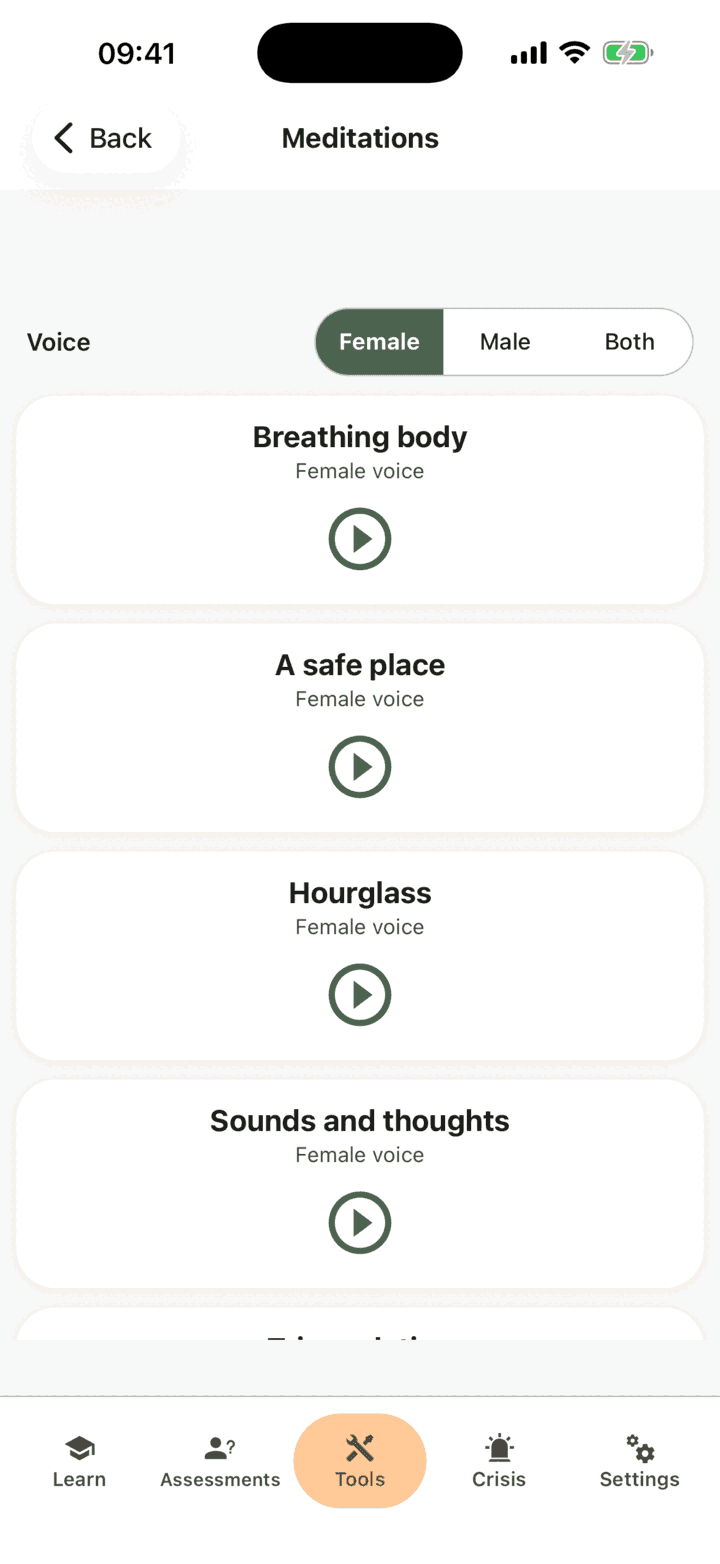
A way to begin:
- Choose a cue you already have. After breakfast, or before bed. A habit attached to an existing routine is easier to keep.
- Start with Breathing body. Sit or lie comfortably, with your eyes closed or resting on a spot.
- Expect wandering. When you notice it, you have done the exercise. Silently note "wandering," and return.
- Practice a few times a week. Many people find a little practice often easier to keep up than a long session now and then.
- Notice, then move on. After a session, take a few seconds to notice how you feel. Do not grade the session.
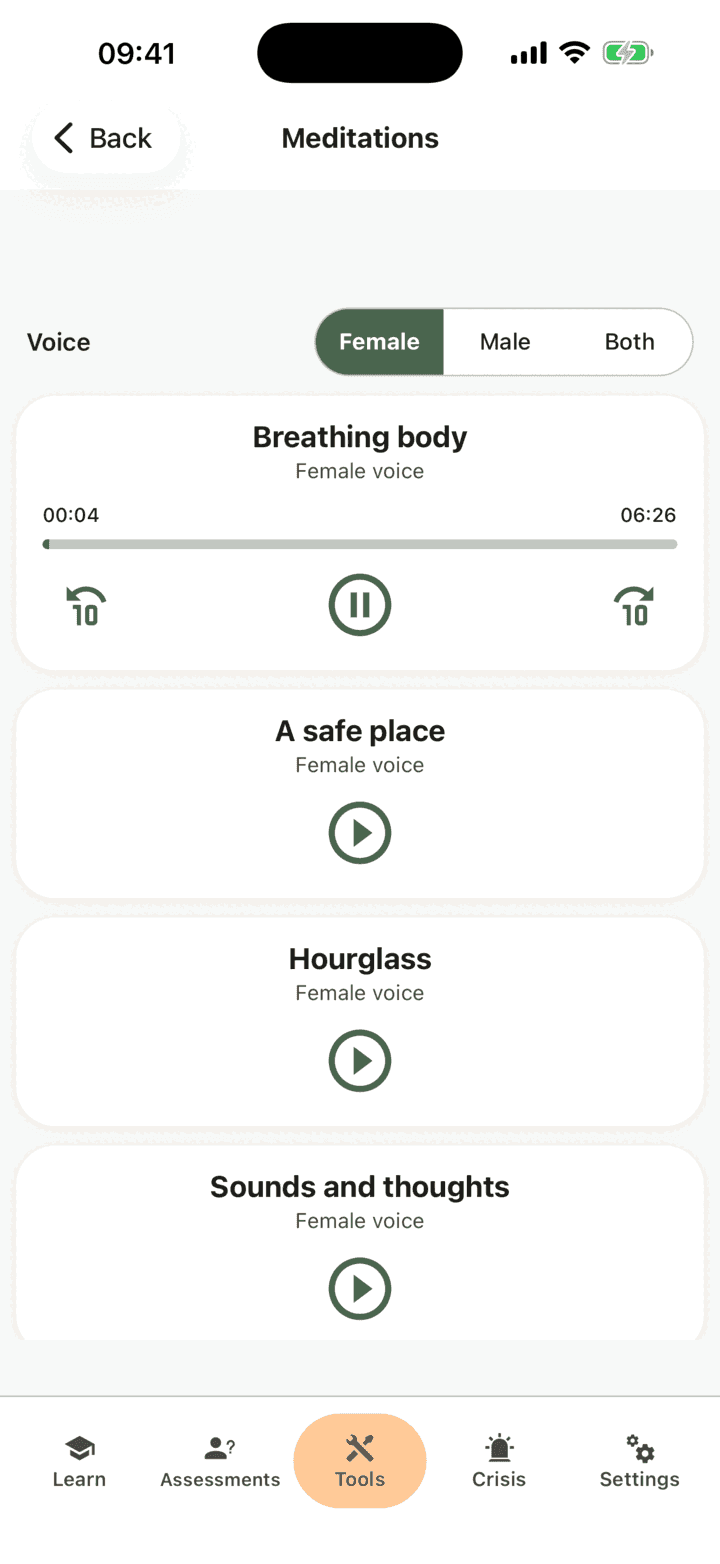
Free accounts can listen to a meditation once every three days, and Premium accounts have unlimited listening.
Using mindfulness with your other tools
Noticing a thought is the first step in a Dysfunctional Thoughts Test, and mindfulness practice makes that step easier. Naming "this is a worry" in a Worry Tree is the same move.
When to get more help
Mindfulness is a skill for everyday life, not an emergency tool. If you feel hopeless, think about harming yourself, or find it hard to get through the day, please talk to your therapist or doctor. In the app, you can open the Crisis tab at any time.
Sources and further reading
- Kabat-Zinn, J. (1990). Full Catastrophe Living. Delacorte.
- Bishop, S. R., et al. (2004). Mindfulness: a proposed operational definition. Clinical Psychology: Science and Practice, 11(3), 230-241.
- Segal, Z. V., Williams, J. M. G., & Teasdale, J. D. (2013). Mindfulness-Based Cognitive Therapy for Depression (2nd ed.). Guilford Press.
- Teasdale, J. D., et al. (2000). Prevention of relapse/recurrence in major depression by mindfulness-based cognitive therapy. Journal of Consulting and Clinical Psychology, 68(4), 615-623.
- Teasdale, J. D., et al. (2002). Metacognitive awareness and prevention of relapse in depression. Journal of Consulting and Clinical Psychology, 70(2), 275-287.
- Kuyken, W., et al. (2015). Effectiveness and cost-effectiveness of mindfulness-based cognitive therapy compared with maintenance antidepressant treatment in the prevention of depressive relapse or recurrence (PREVENT). The Lancet, 386(9988), 63-73.
- Kuyken, W., et al. (2016). Efficacy of mindfulness-based cognitive therapy in prevention of depressive relapse: an individual patient data meta-analysis. JAMA Psychiatry, 73(6), 565-574.
- Hölzel, B. K., et al. (2011). How does mindfulness meditation work? Perspectives on Psychological Science, 6(6), 537-559.
- Parsons, C. E., Crane, C., Parsons, L. J., Fjorback, L. O., & Kuyken, W. (2017). Home practice in mindfulness-based cognitive therapy and mindfulness-based stress reduction: A systematic review and meta-analysis of participants' mindfulness practice and its association with outcomes. Behaviour Research and Therapy, 95, 29-41.
- Farias, M., et al. (2020). Adverse events in meditation practices and meditation-based therapies: a systematic review. Acta Psychiatrica Scandinavica, 142(5), 374-393.
- Linehan, M. M. (2014). DBT Skills Training Manual (2nd ed.). Guilford Press.
- Hayes, S. C., Strosahl, K. D., & Wilson, K. G. (2011). Acceptance and Commitment Therapy (2nd ed.). Guilford Press.
- Wells, A. (2009). Metacognitive Therapy for Anxiety and Depression. Guilford Press.