Questionnaires: What Your Scores Show, and What They Do Not
You answer a handful of questions, tap a button, and a number appears. It is natural to wonder what it means. Is it good? Is it bad? Is something wrong with me? This article explains what a screening questionnaire is, what a score can tell you, and, equally, what it cannot.
What is a screening questionnaire?
A screening questionnaire is a short list of questions about how you have felt recently, with a fixed set of answers for each. You choose the answer that fits best. Each answer has a value, and the values add up to a score. Because the questions and the scoring are the same every time, the result can be compared: with an earlier result of your own, and with what researchers have learned from many people who answered the same questions.
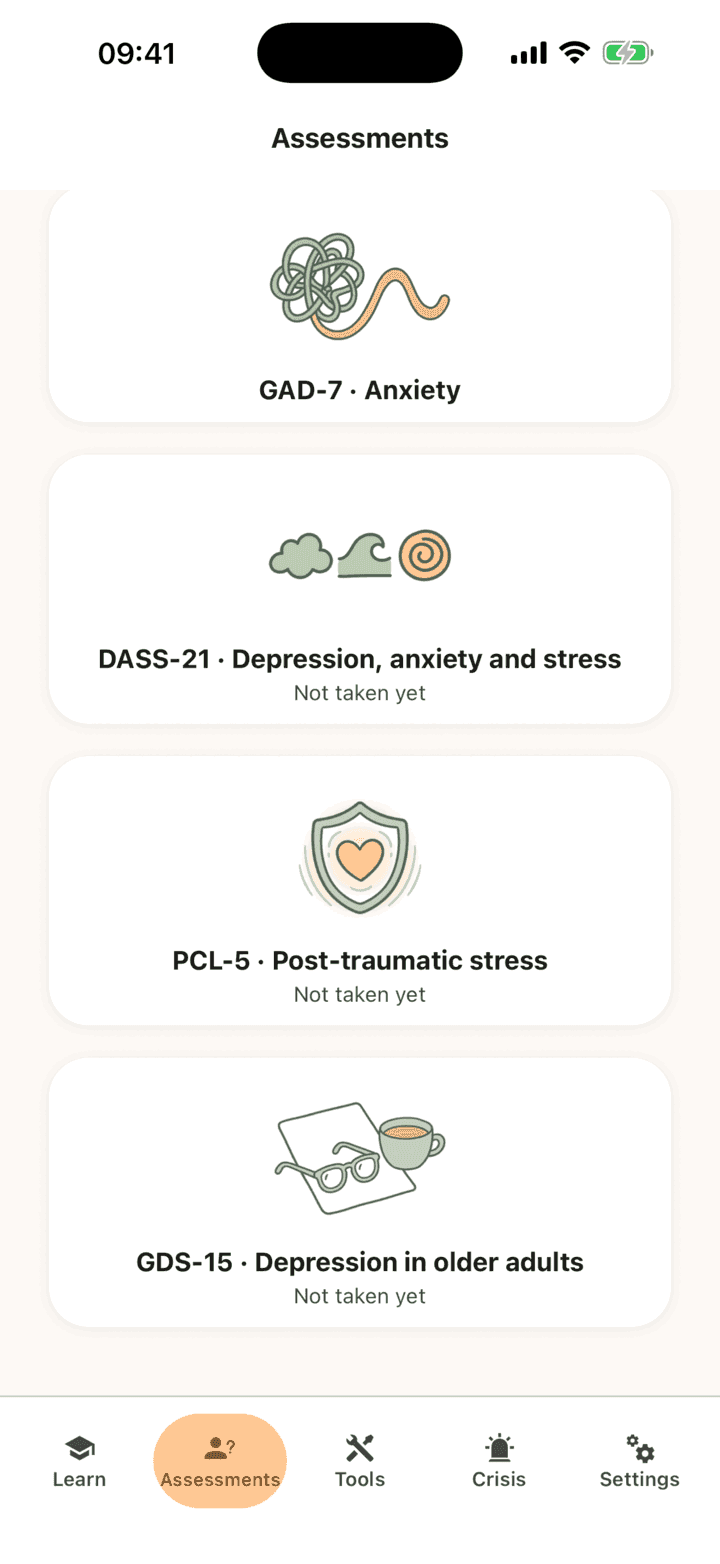
The Assessments tab in CopingCard holds standard questionnaires of this kind, the ones doctors and therapists use widely. The PHQ-9 (Patient Health Questionnaire-9), for example, asks nine questions about low mood and related experiences, such as interest in things, sleep, energy and concentration, and the GAD-7 (Generalized Anxiety Disorder-7) asks seven about worry and anxiety. Questionnaires like these have been tested in many studies as a quick, reliable way to describe symptoms.
Three more questionnaires are in the same list. The DASS-21 (Depression Anxiety Stress Scales-21) asks 21 questions about the past week, grouped into low mood, anxiety and stress, and suits someone who wants to see those three side by side. The PCL-5 (PTSD Checklist for DSM-5) asks 20 questions about how much problems that can follow a very stressful experience, such as unwanted memories, avoiding reminders and feeling on edge, have bothered you over the past month, and suits someone who has lived through such an experience. The GDS-15 (Geriatric Depression Scale-15) asks 15 yes-or-no questions about mood over the past week, and was made for older adults.
Each questionnaire asks about a set period, such as the past week, the past two weeks or the past month, and its instructions say which. That period is what your answers describe.
Measurement is part of CBT
Cognitive behavioral therapy (CBT) is a family of therapies that treat ideas about what is going on as hypotheses and test them. A hypothesis needs data. Measuring progress is therefore part of the core of CBT, not an add-on: a therapist and client agree what they are aiming at, check regularly whether things are moving, and change the plan when they are not. Questionnaires are one source of that data, next to what you tell your therapist and what you notice in daily life.
There is evidence that this works. In a meta-analysis of routine outcome monitoring, collecting scores and giving feedback to clients and therapists improved outcomes, most clearly for clients who were not improving as expected, because it prompted a change of plan earlier.
What a score is
A score is a snapshot of how that period looked, in a form that is the same each time. That is its strength. It gives you and your therapist a shared reference point, instead of a vague "I think it has been a bit better."
A score also helps to put words to things that are hard to say. Seeing a question such as "feeling nervous, anxious or on edge" and choosing an answer can be easier than starting a conversation from nothing.
What a score is not
It is not a diagnosis. Only a trained clinician, who knows you and your life, can say what is going on. A questionnaire cannot see your circumstances, your history, or what a hard stretch has meant for you. Two people with the same score can be in very different situations.
It is not a verdict on you. A high score is not a verdict on you or a sign of weakness. It does show that the period it asks about was hard, and it is a good reason to talk with someone. A low score does not mean you have nothing to talk about. Both are information about that period.
It is not a test you can fail. There is no good or bad result to aim for. If you answer to get a lower number, the number will be less useful to you, and the only person who loses is you. Answer for how you actually felt.
It is not precise. Mood moves up and down. A single bad week can change a score, and so can how you feel on the day you answer. Treat the number as a rough guide, not a measurement to the decimal.
Why repeating it helps
One result tells you where you are today. Two or three, taken every few weeks, show the direction: whether things are moving, staying steady or slipping. That is useful because change often feels too slow to notice from the inside. People are often surprised to see on paper that a few weeks ago was harder than today.
It also helps your therapist. If you are in treatment, tracking scores over time is one way that you and your therapist can see whether what you are doing is working, and decide together whether to keep going or try something different. If a score is not changing, that is not a failure on your part. It is a signal to talk about what might be adjusted.
The app can keep your results together and show how they change over time, and you can set a reminder to take a questionnaire again. Because each questionnaire covers a set period, taking it again before that period has passed gives you little new.
Reliable change: more than noise
Scores move around with mood, sleep, the week you had and even the time of day. So the question after a second or third result is not "did the number change?" but "is the change bigger than the ordinary wobble?" Researchers call a change that exceeds measurement noise a reliable change. The usual method compares the size of the change with the measure's reliability (Jacobson and Truax, 1991). For the PHQ-9, a change of a point or two is within the noise for most people, and a larger shift that holds across more than one result is worth taking seriously. Your therapist can help you read it. A reliable change in the wrong direction is not a verdict either. It is a reason to look at the plan together.
Symptom measures and process measures
Questionnaires such as the PHQ-9 are symptom measures. They tell you how much of a symptom, such as low mood or worry, has been present. They do not tell you why it keeps going. Modern CBT therefore also follows processes, the things that maintain difficulties or help them ease: avoidance, rumination, sleep, activity, values-based action. Process measures, such as the Process-Based Assessment Tool (PBAT) used in process-based research, ask about these directly. A symptom score and a record of processes, together, give a better picture than either alone. In CopingCard, tools such as check-ins and the diary card record some of the processes, and your therapist can help connect them to your scores.
What the app adds to a paper questionnaire
On paper, you fill in a form, and then the page goes in a drawer. Repetition is what makes a questionnaire useful, and the app is built to make repeating it easy.
- A reminder to take it again. After each result the app proposes a reminder one month ahead. You can move it to another date and time, or switch it off. It arrives as a notification on your phone.
- Your results in one place. Each result is saved. Under each questionnaire, a Trends chart shows one point for each day you took it, over a week, a month, three months, six months or up to a year, so you can see direction without keeping your own list.
- Look at it with your therapist. If you share your data with your therapist, you can look at your results together, as a table and as a history chart for each questionnaire. A therapist can also assign a questionnaire as homework, once or repeating, such as monthly, or fill one in with you during a session. Homework counts as done when you take that questionnaire in the app after it was assigned.
- Your plan and crisis lines on every result. Whatever the score, the result screen shows a way to your safety plan and to crisis lines.
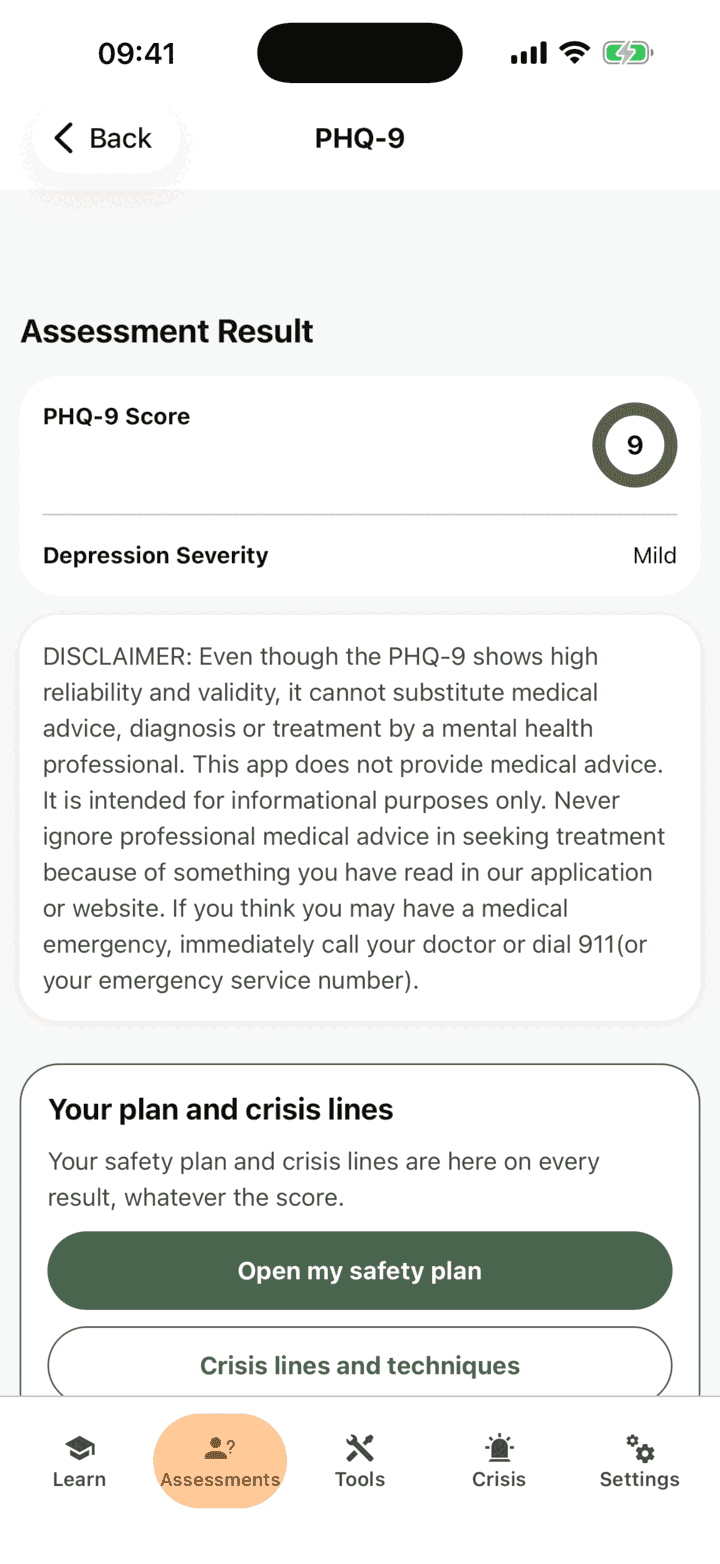
The research behind this is on routine outcome monitoring: collecting scores regularly and sharing them with the therapist improves outcomes, most clearly for clients who are not improving as expected (Lambert, Whipple and Kleinstäuber, 2018). The app shows the score and its band; it does not interpret individual answers or alert anyone.
Taking a questionnaire: step by step
- Choose a good time. A quiet few minutes, not in the middle of a rush.
- Open the Assessments tab and choose the questionnaire.
- Answer for the period the questionnaire names, not for today alone, and not for the best or worst day.
- Go with your first answer. Do not overthink it.
- Answer every question. The score cannot be worked out with gaps.
- Look at your result calmly. Notice how it feels, and remember it is a snapshot.
- Bring it to a conversation. Show it to your therapist or your doctor, and talk about what it means for you.
Talking about your results
The most useful thing you can do with a score is to talk about it. You might say:
- "This is how I answered. Does it match what you see?"
- "This question stood out to me. Can we talk about it?"
- "It went up, and I am not sure why."
- "It went down. What do you think changed?"
If you do not work with anyone yet, take it to your doctor. A result that worries you is a good reason to book an appointment.
What the app does with your answers
CopingCard keeps your results together and shows how they change over time. It does not react to individual answers, including the PHQ-9 question about thoughts of harming yourself. The questionnaire is not a safety check, and nobody is notified. If any answer reflects something you are living with, tell your therapist or your doctor, or open the Crisis tab, instead of leaving it to a number. You never need a particular score to reach out.
When to get more help
If your answers show that things have been hard for a while, or if daily life is getting difficult, please talk to a therapist or your doctor. You do not need a particular score to deserve support, and a low score does not mean you must manage alone. If you feel unsafe at any point, open the Crisis tab in the app, or contact your local emergency services.
In short
- A screening questionnaire is a structured way to describe a recent period.
- A score is a snapshot. It is not a diagnosis and not a verdict on you.
- Repeating it over time shows change that is hard to see day to day.
- Answer honestly. There is no result to aim for.
- Talk through your results with a clinician.
The PHQ-9 is described by Kroenke, Spitzer and Williams (2001) and the GAD-7 by Spitzer, Kroenke, Williams and Löwe (2006). The value of tracking scores during treatment is discussed by Lambert, Whipple and Kleinstäuber (2018). Reliable change is from Jacobson and Truax (1991), and the PBAT is described by Ciarrochi, Sahdra, Hofmann and Hayes (2022).