Core Beliefs and the Downward Arrow: Finding and Changing the Belief Underneath
Some thoughts are reactions to one moment. Others keep returning in different clothes, no matter what happens: when you make a small mistake, when someone is brief with you, even when you are praised. If the same painful theme runs under many situations, you may be meeting a core belief. This article explains what core beliefs are, how a technique called the downward arrow can help find yours, what schema therapy adds to the picture, and how beliefs change.
Three levels of thinking
CBT describes thinking on three levels.
Automatic thoughts are on the surface. They are quick and specific: "That email came out wrong."
Rules and assumptions are in the middle. They are the "if... then..." and "I should..." statements people build to get through life: "If I never make mistakes, people will respect me." "I must always be useful."
Core beliefs are at the bottom. They are broad, firm, absolute ideas about yourself, other people or the world: "I'm useless", "I'm unlovable", "I'm helpless". Judith Beck groups unhelpful core beliefs under themes such as helplessness, unlovability and worthlessness.
Core beliefs often form early, out of experiences that made sense at the time; some form later, after hard events in adult life. They feel less like opinions and more like facts. The rules in the middle often grow up around them as protection: if I believe "I'm useless", the rule "I must never make a mistake" is a way of keeping the belief from being exposed.
Why a belief lasts: the filter and the compensation
If a belief is unhelpful, why does it persist for years? Two reasons.
It works like a filter. Information that fits is noticed and kept; information that does not fit is discounted. Take Dan. A small mistake in a report brings the thought "If I make a mistake, I'm useless." He fixes it in ten minutes. His team lead says it was fine. The mistake counts as proof; the quick fix and the reassurance are explained away ("anyone could have done it", "he is being polite"). Over the years the belief collects confirmations and loses its exceptions.
It is protected by compensatory strategies. Dan works late and checks every report three times. These strategies make sense and often bring success, so they are praised. But they have a cost: they keep him exhausted, and because he never relaxes his standards he never learns what would happen if he did. The belief is never tested.
Where a belief comes from: the schema therapy view
Schema therapy, developed by Jeffrey Young for people who were not helped enough by standard cognitive therapy, is a member of the CBT family that looks at the developmental origin of core beliefs. It proposes that children have core emotional needs: safety and stable attachment, autonomy, freedom to express needs and feelings, spontaneity and play, and realistic limits. When these needs are repeatedly unmet, early maladaptive schemas can form, which are lifelong patterns of thought, feeling and body response, such as defectiveness or failure. The approach also describes modes: the emotional states that take over in the present, such as a vulnerable child, a punishing or demanding inner critic, a detached protector, and the healthy adult who can balance them. People cope with a schema by surrendering to it, avoiding it, or overcompensating, which fits Dan's overwork.
You do not need to adopt this framework to benefit from the idea. Understanding where a belief came from often softens the painful feelings tied to it, self-blame included: you did not choose it; it was a reasonable conclusion for the child who drew it. It also explains why argument alone changes a belief so slowly.
The downward arrow
The downward arrow, described by Burns and widely used in cognitive therapy, follows a thought down to what lies under it. You start with a thought and keep asking one question: "If that were true, what would it mean about me?"
Dan's chain:
- "I made a mistake in the report."
- If that were true, what would it mean? "I'm not careful enough."
- If that were true, what would it mean? "I'm useless."
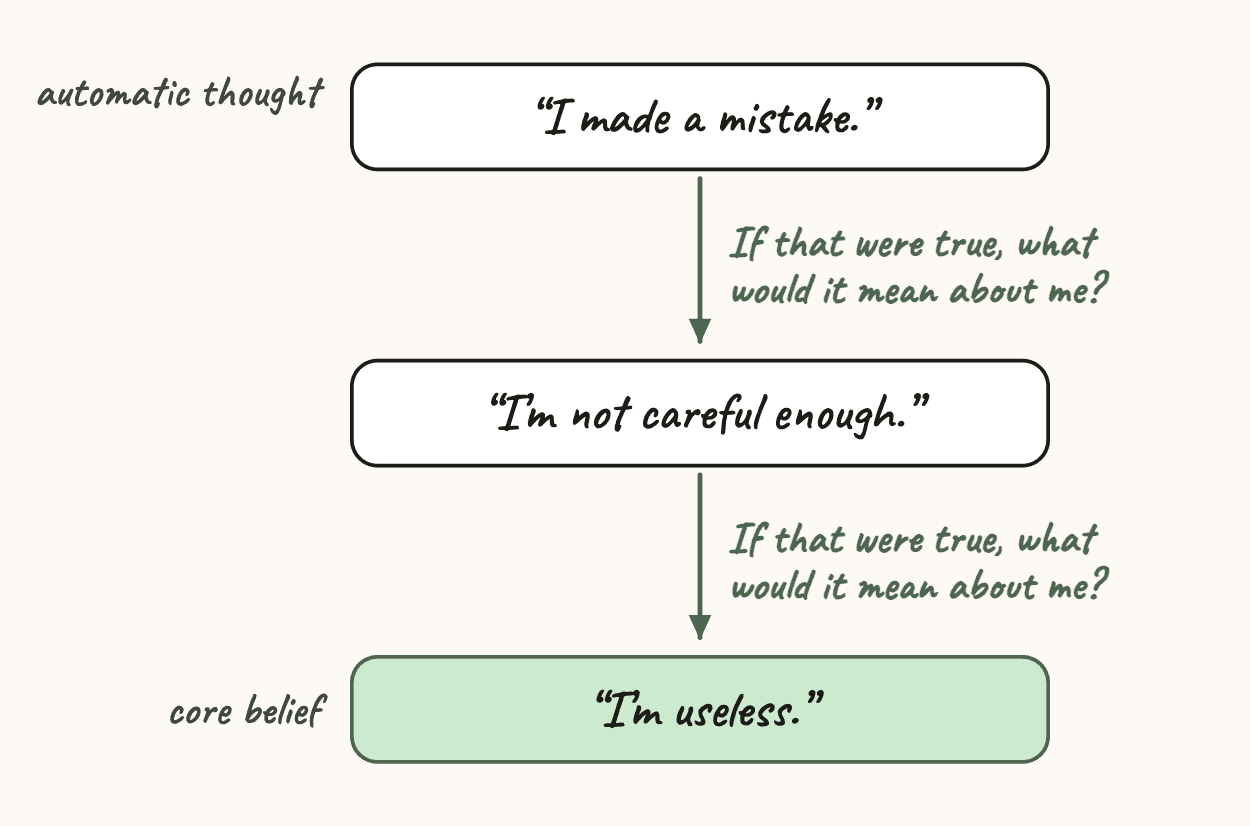
You can tell you have reached the bottom when the answers begin to repeat, when the statement is about who you are rather than what happened, or when the feeling gets noticeably stronger. Seeing the sentence written down can be a relief. It stops being vague dread and becomes something you can look at.
What the app adds to a paper chain
A chain on paper is easy to write once and lose. In CopingCard it stays where you can find it, and it can be shared.
- The question is built in. Under your starting thought the app asks, "If that were true it would bother me because it would mean...". Each answer opens the next box, so the chain is as long as you need.
- A chain you can return to. Once you tap Save, the chain is kept. The list shows the first thought of each chain, with the most recently changed first. Open one to change a step or add the next, as the belief becomes clearer over days or weeks.
- Work on it with your therapist. If you share your data with your therapist, you can go through your chains together. If you also allow editing, they can build a chain with you during a session, and you see it in your app.
- Homework and reminders. A therapist can assign a downward arrow as homework, due once or repeating, with reminders at the due time. It counts as done when you save a new chain. You can also add one to your own homework, set your own reminder, and add it to your phone's calendar.
The chain itself does not rate the belief or keep the log of evidence described below: keep the log in a notebook or a note on your phone, and test the belief in the app's Behavior Experiments or with your therapist. The case for scheduled follow-through comes from research on homework in CBT, where more completed between-session work is linked to better outcomes (Kazantzis and colleagues, 2016).
Using Downward Arrows in CopingCard
- Open Downward Arrows and tap Create Downward Arrow. Write your starting thought, for example one that came up in a recent Dysfunctional Thoughts Test.
- Answer the prompt: "If that were true it would bother me because it would mean..."
- Repeat. Each answer becomes the next thought to ask about. Add as many as you need.
- Look at the chain, an ordered list from your starting thought to the belief at the bottom, and tap Save.
- Bring it to your next session, if you have a therapist.
Go at your own pace. Digging for deep beliefs can bring up hard feelings. You can stop at any point. Nothing is saved until you tap Save, so save first, and the chain will be there when you return.
How a belief changes
Core beliefs rarely flip overnight. They change gradually, usually over months and often longer, and CBT has several complementary routes.
Treat the belief as a line, not a point. Instead of "true or false", rate how much you believe it, from 0 to 100 percent. If Dan's "I'm useless" falls from 90 to 60 over a few weeks, that is a real change even though the pull is still there.
Build a new belief, not only weaken the old one. Christine Padesky stresses that a fairer alternative has to be developed and strengthened. For Dan: "I'm a person who does many things well and sometimes makes mistakes, like anyone."
Keep a log of evidence. Each day, write down one or two small things that fit the new belief. This trains attention to notice what the old filter discarded. A notebook or a note on your phone will do.
Test the rules with behavior experiments. "I must never make mistakes" becomes a prediction: if I leave one small typo in an email, what will happen? Planning this with a therapist keeps the step manageable.
Work with feeling, not only thinking. Because a belief is held emotionally, therapists also use experiential methods: imagery rescripting, where a painful memory is revisited and its meaning changed, and chair work, where parts of yourself speak to each other. These are best done with a trained therapist.
Where this fits in the CBT family
The downward arrow belongs to the cognitive model, where it connects an automatic thought to the beliefs behind it and feeds the formulation: how the belief developed, what keeps it going, and where to start. Behavioral experiments test the rules. Schema therapy adds a developmental and experiential layer. Compassion-focused therapy works with the shame that often sits with such beliefs. Acceptance-based approaches ask a different question: not whether the belief is true, but what you want your life to be about while it is present.
When this works less well
If you have trouble finding a belief, that is common; you can work at the level of automatic thoughts instead. If the belief is linked to painful memories, or you feel overwhelmed, stop and take it to a therapist. If the belief is about being a burden or not wanting to be here, please do not carry it alone.
When to get more help
Working with deep beliefs can stir difficult feelings. If you feel overwhelmed, if memories of painful events come up, or if you have thoughts of harming yourself, stop and talk to a therapist or doctor. If you are in crisis, open the Crisis tab in the app or contact your local emergency number. You do not have to deal with this alone.
Sources
- Beck, J. S. (2021). Cognitive Behavior Therapy: Basics and Beyond (3rd ed.). Guilford Press.
- Beck, A. T., & Haigh, E. A. P. (2014). Advances in cognitive theory and therapy: The generic cognitive model. Annual Review of Clinical Psychology, 10, 1-24.
- Burns, D. D. (1980). Feeling Good: The New Mood Therapy. William Morrow.
- Fennell, M. J. V. (1997). Low self-esteem: A cognitive perspective. Behavioural and Cognitive Psychotherapy, 25(1), 1-26.
- Fennell, M. J. V. (1999). Overcoming Low Self-Esteem. Constable & Robinson.
- Padesky, C. A. (1994). Schema change processes in cognitive therapy. Clinical Psychology & Psychotherapy, 1(5), 267-278.
- Young, J. E., Klosko, J. S., & Weishaar, M. E. (2003). Schema Therapy: A Practitioner's Guide. Guilford Press.
- Arntz, A., & Weertman, A. (1999). Treatment of childhood memories: Theory and practice. Behaviour Research and Therapy, 37(8), 715-740.
- Gilbert, P. (2009). Introducing compassion-focused therapy. Advances in Psychiatric Treatment, 15(3), 199-208.
- Hayes, S. C., Strosahl, K. D., & Wilson, K. G. (2011). Acceptance and Commitment Therapy (2nd ed.). Guilford Press.
- Kazantzis, N., Whittington, C., Zelencich, L., Kyrios, M., Norton, P. J., & Hofmann, S. G. (2016). Quantity and quality of homework compliance: A meta-analysis of relations with outcome in cognitive behavior therapy. Behavior Therapy, 47(5), 755-772.
- Giesen-Bloo, J., et al. (2006). Outpatient psychotherapy for borderline personality disorder: Randomized trial of schema-focused therapy vs transference-focused psychotherapy. Archives of General Psychiatry, 63(6), 649-658.